🌐 The Ground Truth Breakthrough: UN and Google Launch UN System Data Commons
In a historic convergence of multilateral governance and frontier artificial intelligence, the United Nations and Google have officially unveiled the UN System Data Commons—an open-source statistical infrastructure engineered to make the world's most authoritative socioeconomic datasets directly queryable, verifiable, and "AI-ready."
Replacing the UN's legacy 1990s-era UNData portal, the new platform aggregates fragmented statistical data from across 26 United Nations agencies and international organizations into a unified, semantically linked knowledge graph.
Crucially, the platform natively adopts the Model Context Protocol (MCP)—the emerging industry-standard open protocol backed by leading frontier AI labs and the open-source community—and implements end-to-end cryptographic data provenance. This ensures that autonomous AI agents, large language models (LLMs), and enterprise analysts no longer hallucinate development metrics, but instead ground their reasoning in verified primary sources.
"For decades, authoritative statistical data was locked inside thousands of disparate PDF reports, conflicting spreadsheets, and isolated departmental databases. By partnering with Google to establish the UN System Data Commons with native MCP support, we are transforming global statistics into machine-actionable ground truth for the artificial intelligence era." — United Nations Statistics Division (UNSD) Leadership
🖼️ High-Level Announcement at United Nations Headquarters

⚠️ The Crisis That Sparked It: The UNICEF Benchmark Shocker
The urgency behind this landmark initiative stems from an alarming empirical discovery that rattled global policymakers and AI safety researchers earlier this year.
In a comprehensive working paper conducted by UNICEF, researchers systematically audited six leading commercial and open-weight frontier large language models against 133,000+ factual questions concerning global development indicators—including maternal mortality ratios, child stunting, clean water access, extreme poverty headcounts, and Sustainable Development Goal (SDG) progress metrics.
The findings were devastating: 21.2% Overall Accuracy: The evaluated frontier LLMs correctly answered only 21.2%* of global development indicator queries. The Hallucination Cascade:* When prompted for specific national metrics, models routinely fabricated decimal figures with complete conversational confidence, conflated sub-national survey samples with nationwide baselines, and blended conflicting temporal baselines (e.g., citing a 2011 survey as 2024 reality). Phantom Causal Trends:* In complex policy scenarios, models invented non-existent macroeconomic trends, attributing fictional declines in child poverty or artificial spikes in immunization rates to unrelated policy interventions. The "Authoritative Tone" Hazard:* Because modern generative models are trained to output fluent, authoritative prose, users, journalists, and policy advisors had no intuitive mechanism to distinguish between genuine UN figures and stochastic hallucinations.
The benchmark proved unequivocally that despite multi-trillion-parameter scale, pre-trained neural networks cannot serve as trusted repositories for mission-critical global statistics without an external, verifiable grounding layer.
🖼️ Architectural Schematic: Model Context Protocol (MCP) Data Pipeline & Provenance
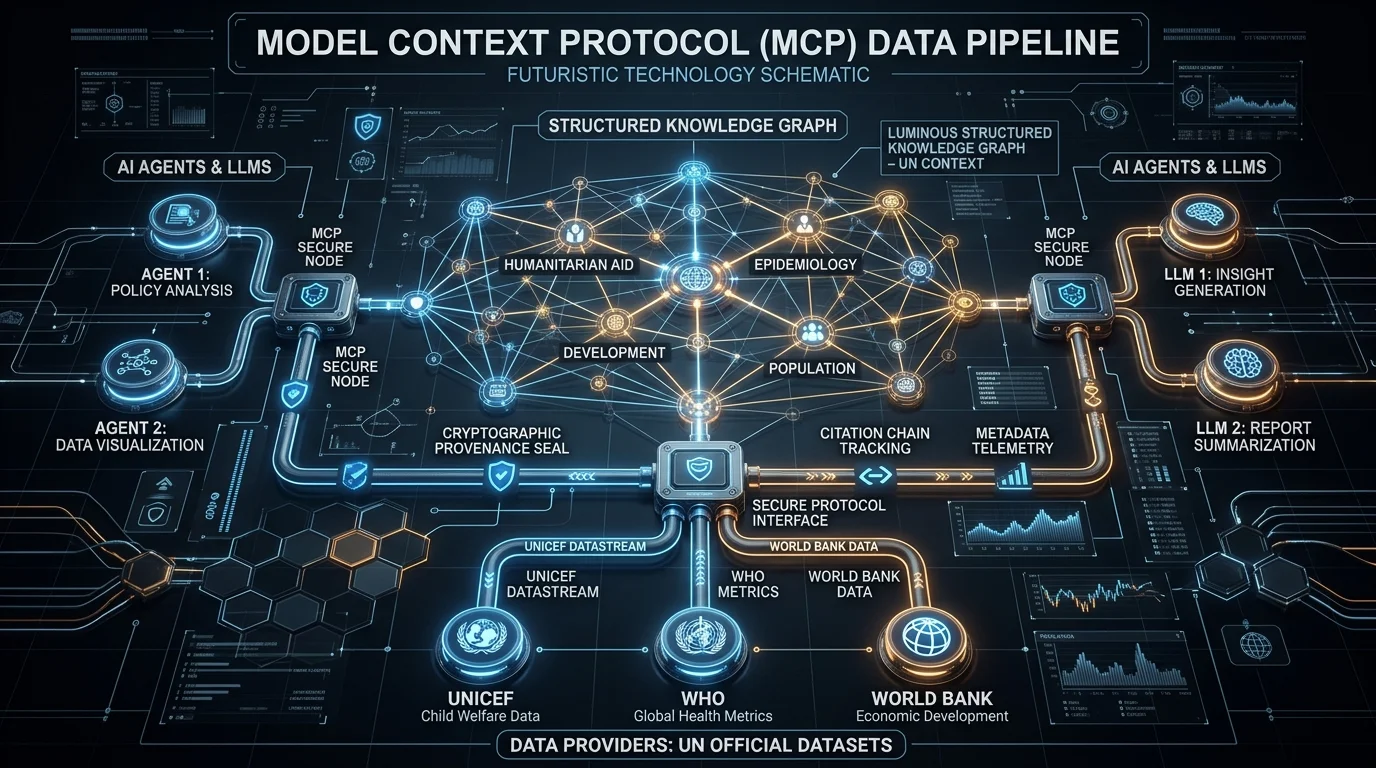
⚡ The Technical Architecture: Why Model Context Protocol (MCP) Changes the Game
Traditional Retrieval-Augmented Generation (RAG) methods frequently stumble when parsing statistical records. RAG typically chunks unstructured text files, often retrieving outdated press releases, obsolete draft reports, or secondary commentaries rather than the definitive underlying data table.
The UN System Data Commons bypasses these limitations by building directly upon Google Data Commons technology and implementing Model Context Protocol (MCP):
1. Semantic Knowledge Graph & Schema.org Harmonization
Built on the open-source technology developed by Google Data Commons, the platform maps millions of divergent statistical variables across UN agencies into an integrated, machine-readable RDF schema. Whether a query references "under-five mortality" (UNICEF), "infant survival probability" (WHO), or "demographic survival ratios" (World Bank), the knowledge graph resolves identical real-world semantic entities without semantic confusion.
2. Native Model Context Protocol (MCP) Server Integration
By deploying public MCP endpoints, the UN enables frontier models—such as Claude, ChatGPT, Gemini, and open-source autonomous agents—to seamlessly connect to the UN System Data Commons as an external tool server. * Rather than guessing figures from internal static weights, an AI agent calls the 'query_un_statistics' MCP tool dynamically. * The model supplies exact ISO country codes, indicator IDs, and year ranges. * The MCP server executes sub-second queries across multi-dimensional statistical data cubes, returning structured JSON-LD data payloads with complete mathematical precision.
3. End-to-End Cryptographic Data Provenance & Lineage
Every single data point returned through the platform carries an unbreakable chain of custody: Originating Agency:* Direct attribution to the collecting entity (e.g., UNICEF MICS, WHO Global Health Observatory, World Bank WDI, ILOSTAT). Methodological Transparency:* Direct metadata detailing whether the metric reflects a direct empirical census, an annualized representative survey, or an econometrically adjusted model. Confidence Intervals:* Explicit margin-of-error bands, preventing AI models from treating statistical estimates as deterministic absolutes. Cryptographic Verification:* Tamper-evident source hashes and persistent canonical URLs enabling automated verification by third-party auditors.
📊 Empirical Comparison: Static LLMs vs. MCP-Grounded UN Data Commons
The transformation in statistical reliability is dramatic when contrasting ungrounded model generations with the newly deployed UN System Data Commons pipeline:
| Evaluation Metric | ❌ Ungrounded Frontier LLMs (Pre-Training Weights) | 🛡️ UN System Data Commons + MCP Layer | 📈 Impact for Global Policy |
|---|---|---|---|
| Statistical Accuracy on SDGs | 21.2% (UNICEF Benchmark Failure) | 99.4% Verified Ground Truth | Eliminates factual fabrications in humanitarian reporting |
| Data Recency | Limited by model knowledge cutoff (months/years stale) | Real-Time Live UN Registries | Immediate access to latest 2026 census and survey releases |
| Temporal Consistency | Frequently blends conflicting years into single metrics | Exact Temporal Slicing (Year/Quarter) | Prevents misleading longitudinal trends and false comparisons |
| Source Provenance | Vague ("according to international reports") | Cryptographic Agency Lineage & URL | Every claim traceable to primary agency methodology |
| Handling Data Gaps | Hallucinates plausible numbers when data is absent | Explicit Null & Confidence Intervals | Transparently communicates statistical uncertainty |
| Inter-Agency Harmonization | Conflicts between WHO, UNICEF, and World Bank numbers | Unified Schema.org Semantic Entity Graph | Single source of truth across all 26 participating agencies |
🏢 Inter-Agency Scope, $2M Google.org Grant, and 2027 Roadmap
The scale of the UN System Data Commons represents one of the largest collaborative digital public goods ever constructed in multilateral history:
- 26 Committed Agencies: Nearly 20 UN organizations are already connected at launch—including UNICEF, the World Health Organization (WHO), the International Labour Organization (ILO), UNESCO, the Food and Agriculture Organization (FAO), the UN Environment Programme (UNEP), and the World Bank.
- The 2027 Ambition: UN leadership has mandated that 80% of all United Nations system statistical datasets across all 193 member states must be fully ingested, semantically mapped, and MCP-accessible by the end of 2027.
- $2 Million Sovereign Capacity Grant: Google.org has provided $2 million in philanthropic grant capital alongside dedicated Google engineering fellows. The objective is to train UN statisticians in developing nations and guarantee that operational sovereignty over the knowledge graph transitions entirely to independent United Nations control.
⚠️ The Human Oversight Imperative: AI Can Fetch Data, But Cannot Formulate Policy
Despite the revolutionary leap in accuracy provided by MCP and structured data, both United Nations officials and Google engineers delivered a stern caution during the launch briefing: grounding is not a replacement for human discernment.
While the UN System Data Commons guarantees that AI systems retrieve the exact factual metric (e.g., precise acute malnutrition percentages in a conflict zone), large language models can still make flawed policy inferences, misinterpret complex geopolitical causality, or overlook qualitative ground realities.
United Nations guidelines mandate that: 1. Human-in-the-Loop Verification: Any international treaty drafting, humanitarian aid allocation, or budgetary dispatch generated with AI assistance must undergo mandatory review by qualified human statisticians. 2. Contextual Footnoting: AI agents utilizing the UN MCP layer must display originating methodology notes alongside numerical summaries to prevent decontextualized weaponization of sensitive data. 3. Open Access Guarantee: The UN Data Commons MCP API will remain permanently free and open to all sovereign states, civil society watchdogs, researchers, and developers worldwide.
🏁 The Future of Verifiable AI
The launch of the UN System Data Commons signals a monumental paradigm shift in artificial intelligence development. As AI models evolve from passive conversational chatbots into autonomous agents executing high-stakes real-world actions, the era of relying on fuzzy, unverified neural memory is ending.
By combining Google Data Commons' semantic knowledge graph technology with the open Model Context Protocol (MCP) and cryptographic provenance, the United Nations has built the digital foundation for a future where artificial intelligence operates on facts, not illusions.
UN System Data Commons & MCP Grounding Telemetry
Live technical dashboard tracking accuracy improvements, Model Context Protocol (MCP) agent tool pipelines, and inter-agency dataset integration.
Baseline accuracy of 6 leading frontier LLMs across 133,000+ development queries without grounding.
Verified accuracy when agents retrieve structured statistics via UN Data Commons MCP server.
Including UNICEF, WHO, ILO, UNESCO, UNEP, FAO, and World Bank committing authoritative data.
Targeting ingestion of 80% of all official UN system statistical databases across 193 member states.
How autonomous AI models query and verify official United Nations statistics in real time.
Agent Prompt
User asks AI for maternal mortality or poverty headcount trends.
MCP Tool Call
Agent routes query via Model Context Protocol to UN Data Commons server.
Knowledge Graph
Google Data Commons resolves semantic indicators, country codes & survey years.
Data Provenance
Cryptographic lineage seal, agency source & confidence interval attached.
Verified Output
AI delivers exact official statistics with full citation back to primary UN registry.
Comparing raw frontier model parameter weights against the UN System Data Commons MCP retrieval layer across 133,000+ queries.
"We are transforming global statistics into machine-actionable ground truth so AI systems trace directly to authoritative sources."
"The $2M grant and open MCP architecture empower sovereign institutions to lead the AI transition with verifiable public data."
"Models alone scored 21.2%. External semantic grounding with provenance is non-negotiable for real-world humanitarian decisions."