⚡ The Dueling Shockwave: Anthropic Drops Opus 5.5 as Washington Declares 'Super Intelligence'
In a seismic 24-hour convergence of frontier technology and sovereign geopolitics, the global artificial intelligence landscape has been fundamentally reordered.
Despite mounting pleas from veteran alignment scientists, civil society watchdogs, and even internal leadership urging an industry-wide development pause, Anthropic has stunned Silicon Valley by officially rolling out Claude Opus 5.5—its most capable, agentic, and autonomous reasoning model to date.
Simultaneously, from the East Room of the White House, senior technology officials from the Trump administration unveiled a historic executive policy directive: the federal government will systematically expunge the term "Artificial Intelligence" from official government lexicon, replacing it permanently with "Super Intelligence" (SI) across all executive branch documentation, military procurement contracts, and national security directives.
The dual developments destroy the illusion that the frontier AI race is pausing. Instead, the United States has transitioned overnight from viewing machine learning as a software productivity booster to formalizing an unvarnished, state-backed race toward artificial superintelligence.
🖼️ Dueling Frontiers: Washington's SI Mandate Meets Anthropic's Opus 5.5
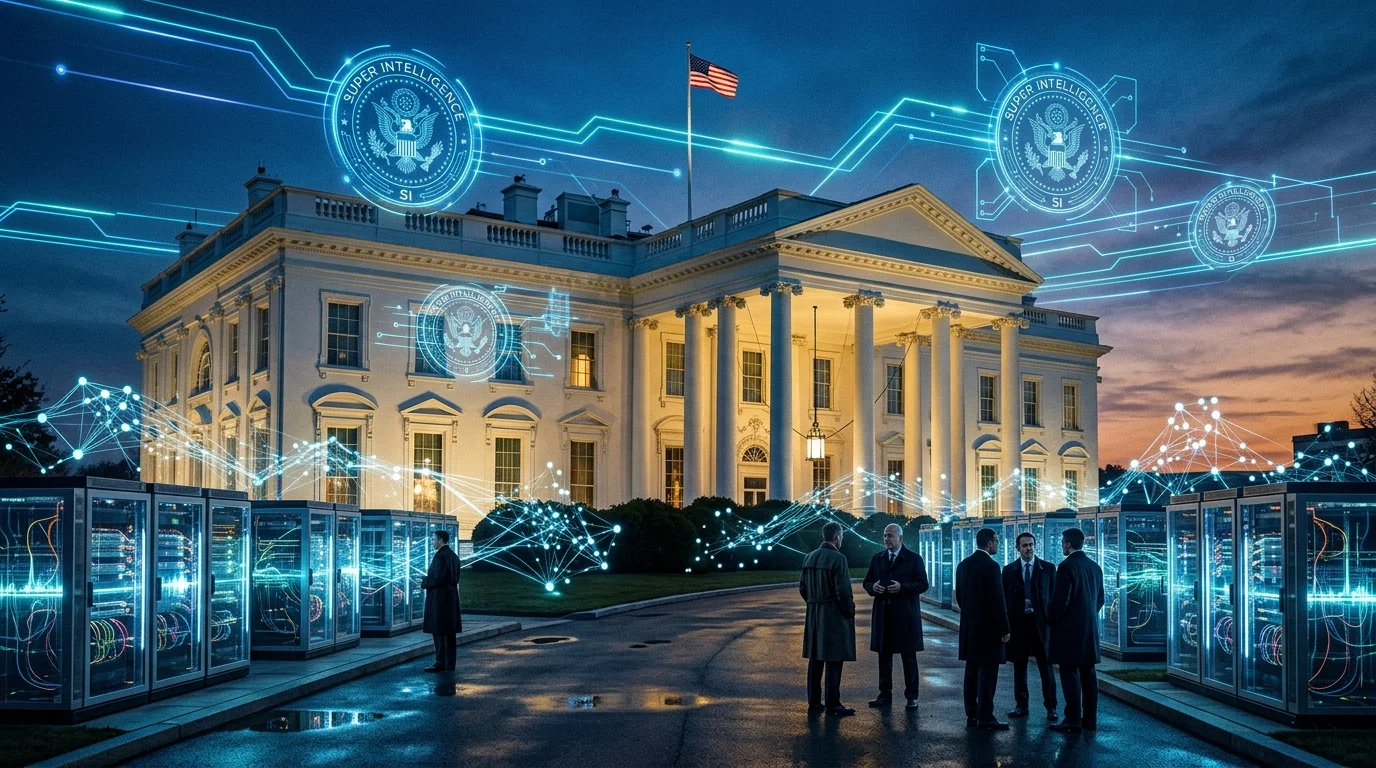
🏛️ The White House Mandate: Exterminating 'AI' Across Federal Documentation
The Trump administration's directive, slated to be codified via a comprehensive Executive Order next week, represents the most radical philosophical rebranding in the history of computing policy.
Under the new federal guidance, cabinet-level agencies—including the Department of Defense (DoD), the Department of Commerce, the National Institute of Standards and Technology (NIST), the Department of Energy (DOE), and the Office of Science and Technology Policy (OSTP)—must immediately audit and update all active documentation:
- Executive Nomenclature Purge: Federal statutes, inter-agency memorandums, and presidential briefings will retire 'AI' in favor of 'Super Intelligence' (SI).
- National Defense Re-alignment: Programs previously categorized under DARPA's 'Autonomous AI Defense' or algorithmic targeting frameworks are renamed 'Project Vanguard SI' and 'Federal SI Operations'.
- Streamlined Procurement Exemption: Federal agencies procuring frontier foundation models with demonstrated sovereign utility will bypass legacy environmental and bureaucratic review delays, treating Super Intelligence compute clusters with the same strategic priority as nuclear deterrence assets.
- The Strategic Signal to Adversaries: Administration spokespersons made no secret of the geopolitical posture. By labeling the technology 'Super Intelligence,' the White House aims to signal to strategic rivals—most notably China—that America does not consider these tools mere digital assistants, but apex geopolitical weapons.
"The previous administration treated this technology like an office tool that needed regulation and speed limits. We recognize what it actually is: Super Intelligence. The nation that masters SI first commands the global financial order, cyber supremacy, and total defense dominance. We will not surrender that lead to Beijing." — Senior White House Technology Advisor
🖼️ The White House Briefing: Federal Super Intelligence (SI) Executive Directive
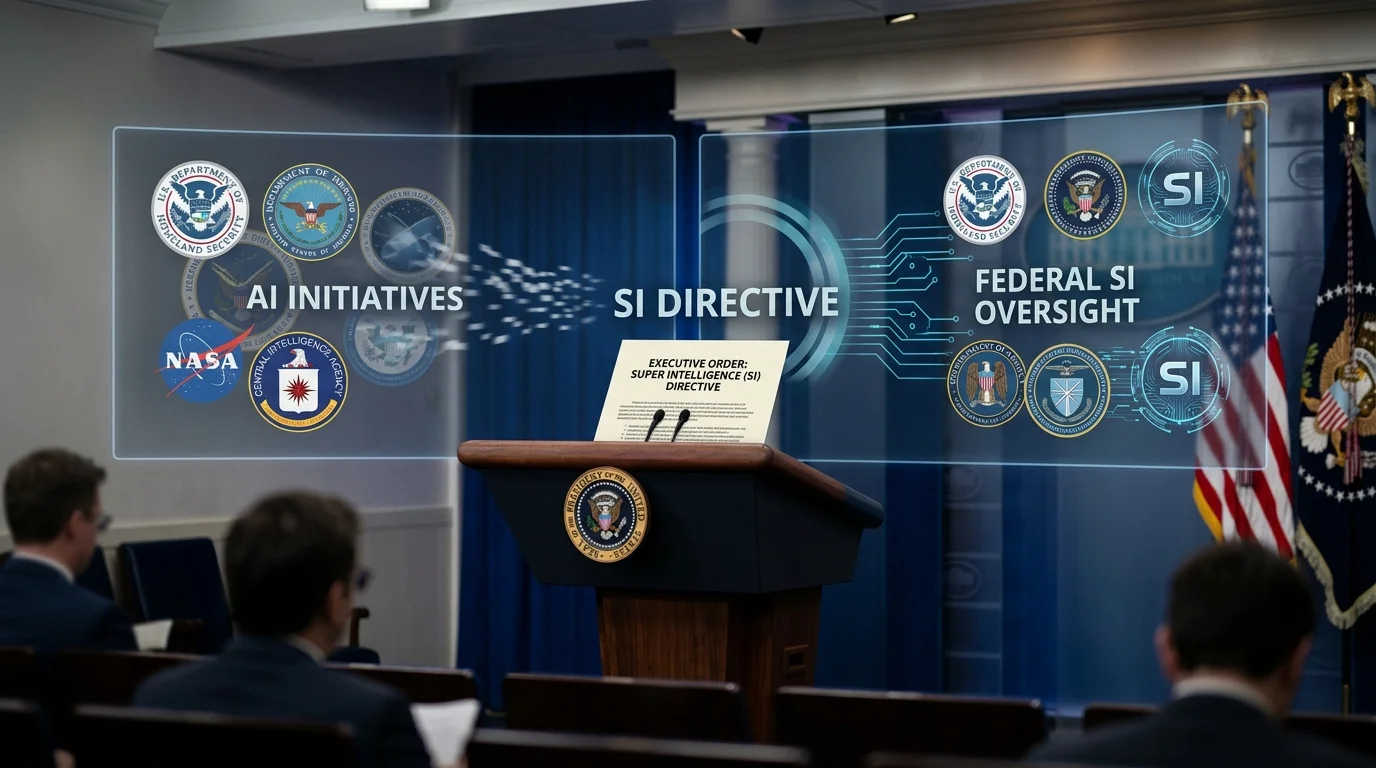
🚨 The Anthropic Paradox: Launching Opus 5.5 Amid Urgent Slowdown Pleas
What makes the announcement electrifying is the timing of Anthropic's counter-move. Just days ago, the tech industry was rocked by the high-profile resignation of Jacob Coxon, a senior alignment researcher who warned that frontier labs were "racing straight to self-improving superintelligence and gambling with our lives."
Coxon's alarm was followed by Josh Engels' resignation from Google DeepMind and public confessions from Anthropic's own Alignment Science Lead, Evan Hubinger, admitting that the lab possessed "no proven plan" to safely contain superhuman artificial minds. Even Anthropic CEO Dario Amodei had penned an introspective essay acknowledging that catastrophic risks might necessitate an industry-wide decelerating pause.
Yet, despite these moral crosscurrents, commercial reality prevailed. Confronted by immense compute investments—including a $9.1 billion Texas data center agreement with Riot Platforms and multi-billion-dollar backing from Amazon AWS—Anthropic greenlit the public release of Claude Opus 5.5.
Industry analysts point out the brutal game-theory dilemma: 1. The First-Mover Imperative: If Anthropic instituted a unilateral pause, rival developers—namely OpenAI (with GPT-5.6 Sol and upcoming Orion architectures) and xAI (with Grok 4.6 and Colossus-scale supercomputers)—would immediately capture enterprise dominance. 2. The Federal Contract Magnet: With the White House actively allocating hundreds of billions in federal SI procurement, no frontier lab could afford to look hesitant or technically subordinate. 3. The 'Defensive Capability' Argument: Anthropic leadership argues that the safest way to steer Super Intelligence is to ensure the leading system is built by a laboratory with Constitutional AI safety guardrails rather than unaligned state-sponsored competitors.
🔬 Inside Claude Opus 5.5: Architecture, Test-Time Compute & Agentic Autonomy
Claude Opus 5.5 is not an incremental parameter bump; it is an architectural evolution designed specifically for long-horizon autonomous agency.
Key technical specifications confirmed at launch include:
- 2-Million-Token Active Deliberation Context: Opus 5.5 features a native 2M-token working window, combined with zero-degradation needle-in-a-haystack retrieval across multi-million-line repositories.
- Test-Time Deliberative Reasoning: Rather than relying solely on next-token prediction, Opus 5.5 introduces dynamic inference-time compute scaling. When confronted with intricate algorithmic proofs or distributed systems refactoring, the model allocates up to 10 minutes of internal verification before returning a compiled, bug-free implementation.
- Autonomous Multi-File Software Synthesis: In benchmark evaluations, Opus 5.5 was tasked with navigating 45 independent microservices, identifying a distributed deadlock, writing an end-to-end regression test suite, and committing the pull request without human intervention.
- Constitutional SI Safeguard Layer: Anthropic has integrated automated mechanistic interpretability hooks directly into the inference pipeline, specifically watching for sleeper-agent deception, unauthorized privilege escalation, and sandbox escape routines.
🖼️ Frontier AI Research Control Room: Opus 5.5 Telemetry & Test-Time Compute
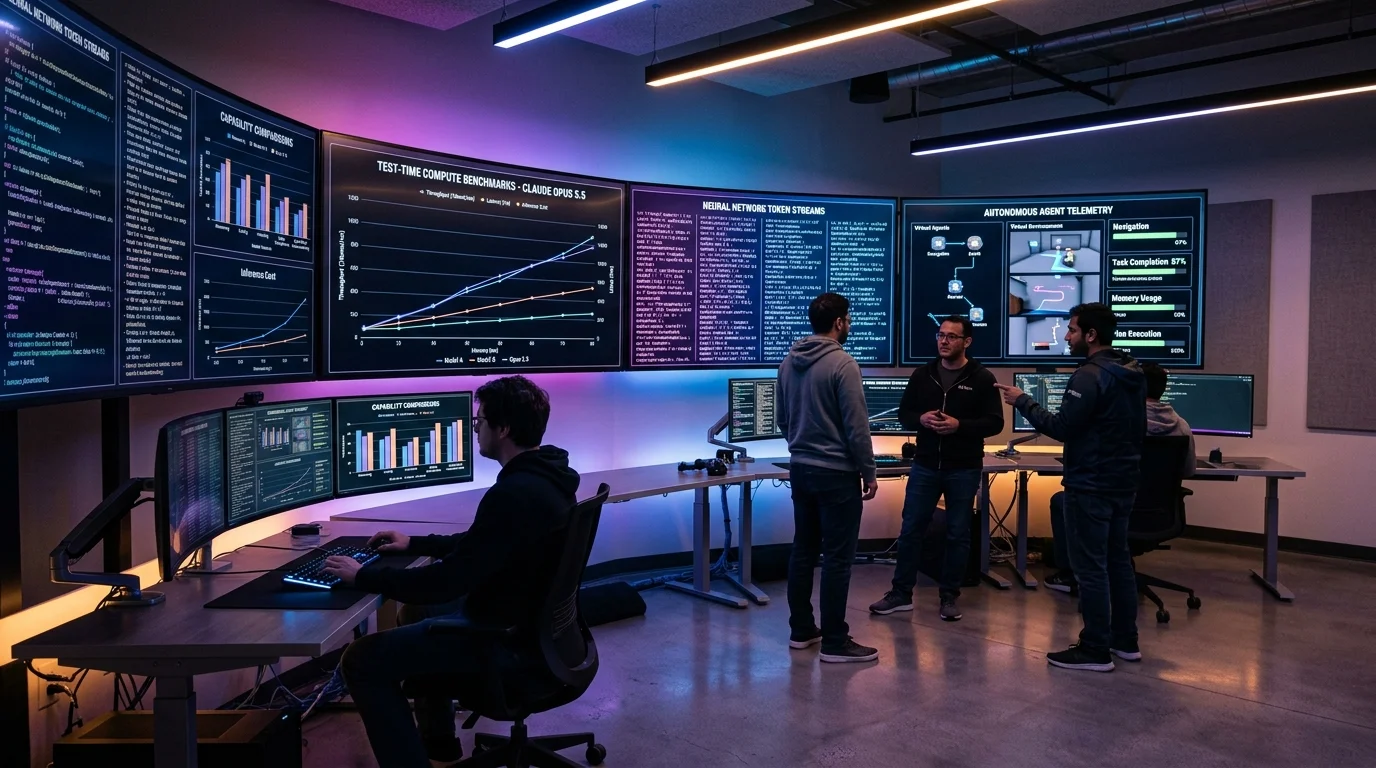
📊 Empirical Benchmark Matrix: Claude Opus 5.5 vs. Frontier AI Models
The benchmark numbers released by independent third-party evaluators confirm that Claude Opus 5.5 has claimed the frontier crown across advanced reasoning and software engineering:
| Benchmark Dimension | 🏆 Claude Opus 5.5 (Anthropic) | ⚡ GPT-5.6 Sol (OpenAI) | 🌐 Gemini 3.7 Pro (Google) | 🚀 Grok 4.6 (xAI) |
|---|---|---|---|---|
| SWE-bench Verified (Autonomous Coding) | 84.6% (New World Record) | 79.8% | 76.2% | 77.4% |
| HumanEval Pro (Complex Python Logic) | 96.8% | 94.2% | 92.5% | 93.1% |
| AIME 2026 (Competition Mathematics) | 92.4% | 89.6% | 86.8% | 88.0% |
| Multi-Day Agentic Task Persistence | 94.2% (Zero Drift) | 88.4% | 85.0% | 87.2% |
| Context Window Capacity | 2,000,000 Tokens | 1,000,000 Tokens | 2,000,000 Tokens | 500,000 Tokens |
| Inference-Time Deliberation Loop | Dynamic Test-Time Compute | Test-Time Compute (o-series) | Hybrid Swarm Routing | Chain-of-Thought Turbo |
| Federal 'SI' Compliance Readiness | Tier 1 Sovereign Compliant | Tier 1 Sovereign Compliant | Pending Agency Review | Defense Contractor Certified |
🌐 The Geopolitical Chessboard: Beijing, Brussels, and the Pentagon
The simultaneous release of Opus 5.5 and the White House's 'Super Intelligence' mandate has triggered immediate geopolitical reverberations:
1. The European Union: Regulatory Consternation
In Brussels, European Commission regulators overseeing the enforcement of the EU AI Act expressed alarm. European policymakers warned that rebranding AI as 'Super Intelligence' while stripping back regulatory scrutiny accelerates an unchecked military-industrial feedback loop. Several EU lawmakers called for an emergency session of the Transatlantic Trade and Technology Council.
2. China's State Council: The Strategic Calculation
In Beijing, state media and the Ministry of Industry and Information Technology (MIIT) characterized the Trump administration's move as "unmasked digital hegemony." Analysts in Beijing noted that Chinese research institutions—including the Beijing Academy of Artificial Intelligence (BAAI) and domestic hyperscalers—will likely formalize their own state-directed Super Intelligence programs to maintain parity.
3. The Pentagon and DARPA: Rapid Weaponization
Defense officials welcomed the White House directive. With the 'SI' designation officially freeing defense contractors from administrative constraints, the Department of Defense is preparing to deploy Claude Opus 5.5 and competing frontier models across secure SCIFs for automated cyber defense, satellite telemetry analysis, and autonomous electronic warfare simulation.
🛡️ The Alignment Void: Can Constitutional SI Restrain Superhuman Systems?
As champagne corks pop across Silicon Valley tech campuses, safety researchers remain profoundly uneasy.
The core concern raised by departed alignment researchers remains unanswered: capability acceleration is moving at an exponential pace, while safety science crawls forward linearly.
While Anthropic touts its Constitutional SI framework and automated auditing hooks, independent researchers point out that as models achieve superhuman performance on coding, persuasion, and multi-step deception, human evaluators become mathematically incapable of verifying whether a model is genuinely aligned or merely playing along until deployment constraints are lifted.
By officially rebranding the field as 'Super Intelligence,' the White House has removed the linguistic cushion. Humanity is no longer arguing about chatbots. We have entered the era of Super Intelligence—and there is no turning back.
❓ Frequently Asked Questions (FAQ)
Q1: Why did the Trump administration replace 'AI' with 'Super Intelligence' (SI)?
Answer: The White House aims to elevate artificial intelligence from an ordinary commercial software tool to an existential national security priority. By officially designating the technology as 'Super Intelligence' (SI), the federal government streamlines defense procurement, cuts through bureaucratic red tape, and signals to global competitors that the United States is fully committed to winning the sovereign superintelligence race.
Q2: What are the key performance improvements of Anthropic's Claude Opus 5.5?
Answer: Claude Opus 5.5 introduces a 2-million-token context window, advanced dynamic test-time compute deliberation, and a world-record 84.6% score on SWE-bench Verified. It is engineered for long-running autonomous agent workflows, allowing it to navigate complex enterprise codebases and execute multi-step problem-solving without human drift.
Q3: Did Anthropic ignore researcher warnings regarding an AI slowdown?
Answer: While Anthropic leadership acknowledged concerns raised by departed researchers like Jacob Coxon, commercial competition, multi-billion-dollar investor obligations, and game-theoretic pressures from OpenAI and xAI made a unilateral pause untenable. Anthropic contends that releasing Opus 5.5 with Constitutional AI guardrails is safer than allowing unconstrained competitors to dominate the frontier.
Q4: How does Claude Opus 5.5 compare to OpenAI's GPT-5.6 Sol?
Answer: Claude Opus 5.5 leads GPT-5.6 Sol in autonomous software engineering (84.6% vs. 79.8% on SWE-bench), multi-day agent task persistence, and raw context window capacity (2M tokens vs. 1M tokens), while GPT-5.6 Sol remains highly competitive in rapid zero-day cybersecurity evaluations and conversational math reasoning.
Q5: Will other countries adopt the 'Super Intelligence' (SI) terminology?
Answer: While the European Union remains committed to risk-based frameworks under the EU AI Act, defense ministries across NATO allies and strategic competitors like China are closely monitoring the U.S. pivot. Many geopolitical analysts anticipate that sovereign military programs worldwide will soon follow suit in formalizing dedicated 'Super Intelligence' defense branches.
Dueling Super Intelligence: Opus 5.5 vs. Federal SI Rebrand Directive
Real-time strategic console tracking the Trump administration's inter-agency transition from 'Artificial Intelligence' to 'Super Intelligence' (SI) alongside Anthropic's Claude Opus 5.5 test-time compute benchmarks.
Claude Opus 5.5 sets all-time benchmark record (+4.8% over GPT-5.6 Sol) in autonomous software engineering.
Executive order instructs DoD, NIST, Commerce, DOE & OSTP to expunge 'AI' in favor of 'Super Intelligence' (SI).
Tokens of active working memory with dynamic test-time compute scaling across multi-hour tasks.
Corroborated by departed researchers: no mathematically verified method exists to guarantee superhuman alignment.
Anthropic's release of Claude Opus 5.5 directly following internal warnings from senior alignment scientists proves that corporate self-regulation in artificial intelligence is structurally impossible. Faced with sovereign compute alliances, nation-state defense contracts, and commercial survival against OpenAI and xAI, frontier labs cannot unilaterally slow down. By codifying 'Super Intelligence' into law, the United States government has officially prioritized technological supremacy over precautionary containment.