🚨 Breaking Aviation Disaster: Fatal Runway Excursion at Miami International Airport
A severe aviation catastrophe unfolded at Miami International Airport (MIA) when an Amazon Air cargo Boeing 767-300F overran the departure end of Runway 09, careening through runway safety barriers and perimeter access roads before coming to rest in saturated turf and gravel.
Local emergency authorities, the Miami-Dade Fire Rescue (MDFR), and federal aviation regulators have confirmed five fatalities in the crash. The victims include all three flight crew members on board the aircraft as well as two airport ground maintenance technicians whose perimeter operations vehicle was struck during the aircraft's high-speed excursion.
The National Transportation Safety Board (NTSB) has launched a full "Go-Team" investigation alongside the Federal Aviation Administration (FAA), focusing on touchdown velocity, standing water on the runway surface, hydroplaning dynamics, and mechanical performance of the aircraft's thrust reversers and autobrake systems.
🖼️ Disaster Scene at Miami International Airport
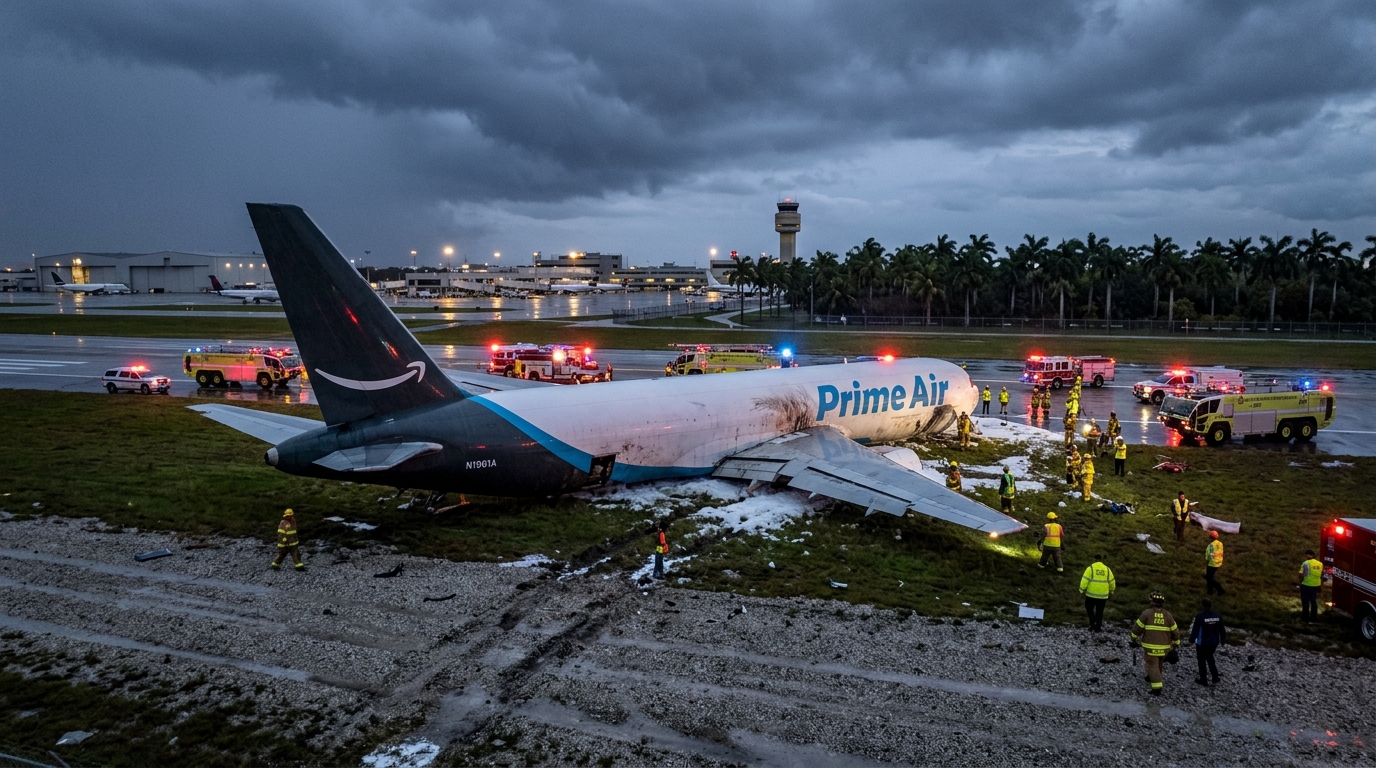
⏱️ Sequence of Events: Touchdown to Overrun
The flight—operating as an Amazon Air dedicated scheduled logistics transit—was inbound to Miami following a domestic freight run. Weather radar at the time of arrival showed severe convective squalls, intense tropical downpours, and gusting crosswinds moving across Biscayne Bay and Miami-Dade County.
- Approach & Windshear Advisory: Air Traffic Control (ATC) at Miami Tower issued Low-Level Windshear Alert System (LLWAS) advisories to arriving aircraft, with rainfall intensity creating heavy surface pooling along Runway 09/27.
- Late Touchdown: Radar tracking data indicates the wide-body freighter touched down significantly beyond the designated runway threshold displacement zone, consuming valuable available stopping distance on the 10,500-foot runway.
- Loss of Braking Friction: Immediately upon main gear contact, telemetry shows the aircraft struggled to achieve optimal anti-skid deceleration amidst widespread hydroplaning on the water-covered tarmac.
- Runway Overrun: Unable to halt before the runway end, the 300,000-pound aircraft crossed the paved overrun zone at approximately 78 knots, demolished perimeter safety fencing, collided with an airport service truck, and suffered catastrophic structural collapse of the nose gear and forward fuselage.
- Emergency Response: Within 90 seconds, Miami-Dade Fire Rescue Aircraft Rescue and Firefighting (ARFF) crews deployed heavy foam suppression lines to blanket the ruptured fuel tanks, preventing a catastrophic full-hull post-crash fire.
👥 Verified Casualties and Ground Impact
Officials from Miami-Dade County and airport administration confirmed the tragic toll of the accident during an emergency press briefing:
| Victim Classification | Personnel Involved | Location at Impact | Official Casualty Status |
|---|---|---|---|
| ✈️ Flight Crew | Captain & First Officer | Cockpit Flight Deck | Fatal (Blunt force trauma from forward fuselage collapse) |
| 💺 Relief Crew | Cargo Jumpseat Observer | Forward Avionics Bay | Fatal (Severe cabin deceleration impact) |
| 🚜 Ground Personnel | Ramp Maintenance Technicians (2) | Perimeter Service Lane Truck | Fatal (Direct impact with right engine nacelle & landing gear) |
| 🚒 First Responders | Airport Fire Rescue Staff (3) | Runway End Suppression Line | Non-Life Threatening (Treated for smoke inhalation & fuel exposure) |
🔬 The Physics of Runway Overruns: Why Wet Runways Become Lethal
Investigating a wide-body runway excursion requires examining the extreme aerodynamics, tire dynamics, and fluid mechanics involved when halting a multi-ton commercial jet:
1. The Three Forms of Hydroplaning
When aircraft land on saturated runways, water pressure separates the tire tread from the pavement, eliminating mechanical friction: Dynamic Hydroplaning: Occurs when standing water lifts the aircraft tires entirely off the asphalt. The critical hydroplaning speed formula (Vp = 9 sqrt(Tire Pressure PSI)) means that at typical 767 tire pressures of 200 PSI, total hydrodynamic float begins at approximately 127 knots. Viscous Hydroplaning:* A thin, microscopic water film acts as a lubricant on smooth or rubber-coated touchdown points, preventing tire grip even at low groundspeeds. Reverted Rubber Hydroplaning:* Locked wheels boil trapped water into superheated steam. The steam cushion melts the outer tire rubber, effectively skiing the aircraft across a pad of molten vulcanized polymer without braking friction.
2. Thrust Reverser & Speed Brake Reliance
On dry runways, carbon brakes provide up to 80% of total aircraft stopping force. On water-saturated tarmac, wheel braking efficiency plummets by 60% to 75%, forcing the aircraft to rely almost entirely on aerodynamic drag from wing speed brakes (spoilers) and reverse engine thrust from the two General Electric CF6-80C2 turbofan powerplants.
🔍 NTSB & FAA Federal Investigation: 5 Key Investigative Pillars
The NTSB has established command headquarters at Miami International Airport. Chief investigators are analyzing critical components retrieved from the crash site:
- 1Black Box Telemetry Extraction: The Digital Flight Data Recorder (DFDR) and Cockpit Voice Recorder (CVR) were recovered intact and rushed under federal escort to the NTSB Vehicle Recorder Laboratory in Washington, D.C.
- 2Reverse Thrust Actuation: Investigators are examining the engine cowl thrust reverser sleeves to determine whether both engines deployed into full reverse thrust simultaneously or if asymmetrical reverse thrust contributed to directional control difficulty.
- 3Runway Surface Grooving & Drainage: Runway 09 is grooved to facilitate rapid tropical water runoff. FAA inspectors are measuring groove depth and rubber deposit accumulation to verify if maintenance met federal friction coefficient standards.
- 4Touchdown Point & Cockpit CRM: Audio logs will evaluate crew decision-making regarding whether a go-around or missed approach should have been initiated upon encountering heavy standing water down the runway.
- 5Aircraft Maintenance & Autobrake Logs: Scrutiny of carrier maintenance records to verify autobrake pressure valves, anti-skid transducers, and carbon brake wear indicator pins.
🌐 Disruption to Airport Operations and Air Freight Supply Chains
Miami International Airport is America's busiest international cargo hub, processing over 2.7 million tons of freight annually. The fatal overrun has caused significant commercial disruption:
- Runway Closure: Runway 09/27—one of MIA's primary east-west arrival corridors—remains closed indefinitely as federal investigators conduct photogrammetry and debris mapping.
- Flight Diversions: Commercial passenger and cargo flights were held in holding patterns before being diverted to Fort Lauderdale-Hollywood International (FLL), Palm Beach International (PBI), and Orlando International (MCO).
- Supply Chain Bottlenecks: Amazon Air and partner logistics operators have shifted priority regional e-commerce shipments to regional trucking hubs and alternate air gateways in Tampa and Lakeland to mitigate nationwide package delivery delays.
📋 Comparative Analysis: Notable Air Cargo Runway Excursions
| Incident & Year | Aircraft Type | Airport Location | Primary Causative Factors | Casualties |
|---|---|---|---|---|
| Miami Amazon Air (2026) | Boeing 767-300F | Miami Int'l (MIA), USA | Heavy water pooling, dynamic hydroplaning, late touchdown | 5 Fatalities |
| Atlas Air Flight 3591 (2019) | Boeing 767-300BCF | Trinity Bay, Texas, USA | Spatial disorientation, inadvertent go-around thrust | 3 Fatalities |
| UPS Airlines Flight 1354 (2013) | Airbus A300F4-622R | Birmingham (BHM), USA | Unstabilized non-precision approach, pilot fatigue | 2 Fatalities |
| FedEx Flight 14 (1997) | McDonnell Douglas MD-11F | Newark (EWR), USA | Hard landing, bounce, loss of directional control | 0 Fatalities |
📞 Official Resources and Inquiries Directory
For families of airport personnel, logistics partners, and travelers seeking information regarding this ongoing investigation:
- NTSB Office of Public Affairs (Air Safety Media Line): +1 (202) 314-6100
- Miami-Dade Aviation Department (MIA Flight Status Line): +1 (305) 876-7000
- Miami-Dade Fire Rescue Public Information Center: +1 (786) 331-5000
- Amazon Air Corporate Communications Bureau: +1 (206) 266-7180
- FAA Aviation Safety Hotline: +1 (866) 835-5322
Miami Airport Runway Overrun Crash Investigation Dashboard
Flight dynamics telemetry, aircraft stopping calculations, wet runway hydroplaning metrics, and NTSB federal inquiry framework.
3 flight crew members & 2 ground maintenance technicians.
Dedicated wide-body Amazon Air freighter (~300,000 lbs MTOW).
Primary 10,500-ft runway cordoned for NTSB debris mapping.
Flight Data Recorder & Cockpit Voice Recorder recovered.
Boeing 767 Stopping Distance vs. Available Runway (10,500 ft)
Calculated landing roll requirements under varying runway surface moisture conditions.
Exceeded 10,500-foot runway length by ~1,400 feet into safety buffer.
Aerodynamic & Mechanical Deceleration Breakdown
Deceleration force contributions during standing water landing roll.
Anti-skid pulsing rapidly due to zero mechanical friction on water layer.
NTSB Federal "Go-Team" Priority Inquiry Tracks
Multidisciplinary forensic investigation authorized under Title 49 of the United States Code.
Airspeed, throttle positions, brake pressure, and cockpit communications.
Verifying symmetric reverse thrust actuation and lockout pin condition.
Friction trailer testing and measurement of water depth in runway grooves.
Glide path deviation, tailwind component, and decision on go-around.
Tire tread depth, anti-skid transducers, and recent maintenance logs.