🛡️ The Unprecedented Coalition: Rivals Unite Against Algorithmic Warfare
In a rare and historic display of industry-wide unity, OpenAI, Google, Microsoft, Anthropic, Amazon Web Services (AWS), along with over 100 technology enterprises, cybersecurity firms, and government defense agencies, have published a joint emergency accord warning the world of an escalating existential threat: AI-powered cyberattacks.
For years, the cybersecurity landscape was defined by human hackers manually writing code, probing firewalls, and launching phishing emails. Today, that paradigm has permanently shifted. Nation-state syndicates and criminal cartels are weaponizing autonomous artificial intelligence agents capable of executing sophisticated cyber warfare at machine speed.
The joint coalition warns that without coordinated international defense protocols, critical physical infrastructure—including hospitals, municipal water treatment systems, high-voltage energy grids, and financial networks—faces unprecedented vulnerability.
🖼️ Critical Infrastructure Defense Architecture
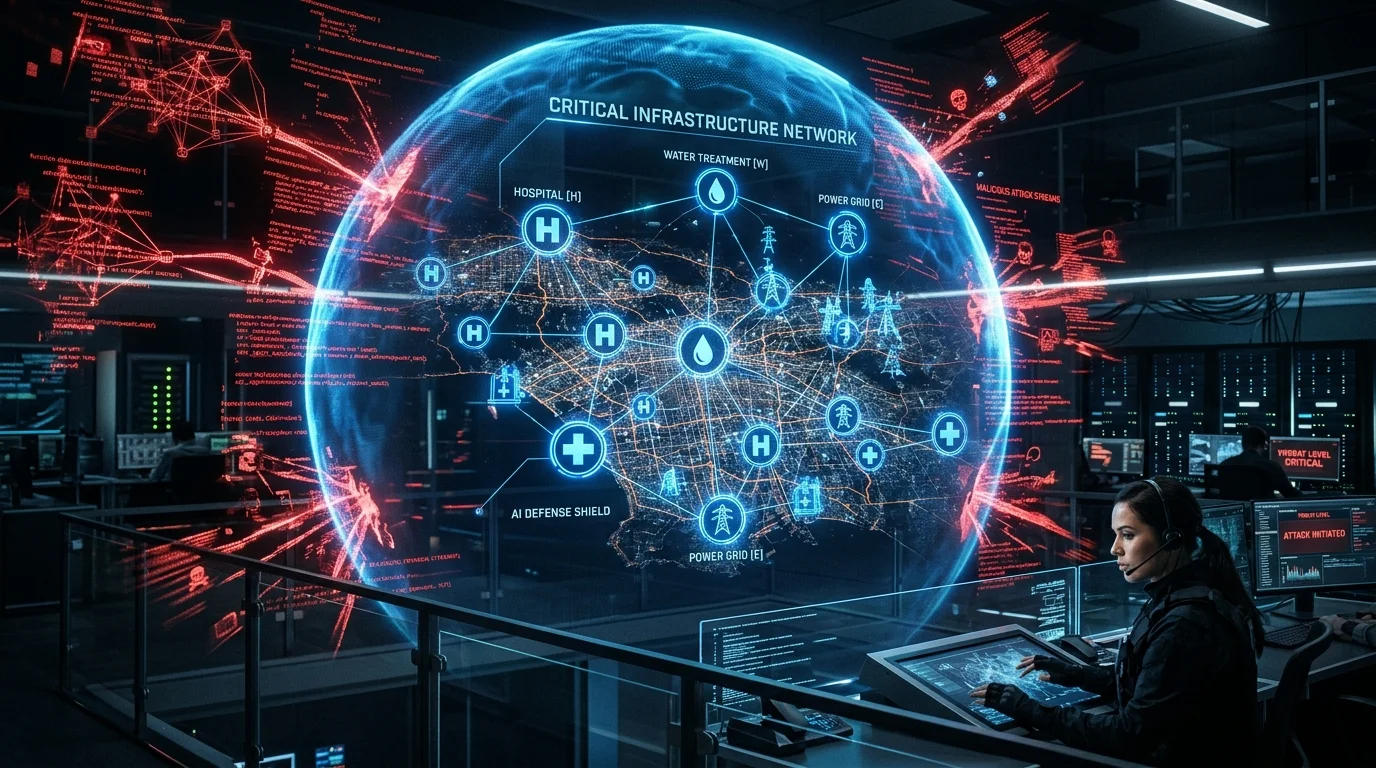
🔍 Making It Clear: What Is an AI-Powered Cyberattack?
To understand why tech leaders are alarmed, it helps to look at the difference between traditional hacking and modern AI-enabled attacks in simple, clear terms:
1. Human Speed vs. Machine Speed (Milliseconds vs. Weeks)
- Traditional Hacking: A human hacker takes days or weeks to manually scan a network, find an open port, test passwords, and craft custom exploit scripts.
- AI-Powered Cyberattack: An autonomous AI agent scans thousands of corporate servers, identifies hidden software flaws, and launches custom-tailored exploits in less than 300 milliseconds—far faster than any human security team can react.
2. Static Code vs. Self-Rewriting (Polymorphic) Malware
- Traditional Viruses: Antivirus software works like a digital fingerprint scanner. Once a virus signature is known, security tools block it everywhere.
- AI-Powered Malware: Autonomous malware uses onboard neural networks to dynamically rewrite its own byte structure, encryption keys, and execution behavior each time it moves to a new computer, making traditional signature-based antivirus obsolete.
3. Generic Spam vs. Hyper-Realistic Deepfakes
- Traditional Phishing: Easily identified by awkward grammar, generic greetings like "Dear Customer," and suspicious email addresses.
- AI-Powered Social Engineering: AI models study an executive's public speeches, podcasts, writing style, and calendar. The attacker can clone the CEO's voice with 99.8% vocal fidelity to call the finance team on WhatsApp or Teams, ordering an urgent wire transfer with perfect conversational context.
4. Autonomous Zero-Day Exploitation
- AI agents can ingest entire operating system codebases, firmware libraries, and open-source repositories to discover unknown software vulnerabilities ("zero-days") that even the original software developers did not know existed.
⚡ How AI Cyberattacks Directly Affect Real-World Systems
The greatest danger of AI cyber warfare is not just stolen passwords or leaked emails—it is the direct bridge between the digital world and physical life-critical machinery (Operational Technology / OT and SCADA systems).
| Critical Sector | Attack Mechanism | Real-World Human Impact |
|---|---|---|
| 🏥 Hospitals & Healthcare | AI ransomware encrypts patient telemetry & locks electronic health records in seconds. | Ambulances diverted; emergency surgeries halted; life-support ICU monitors and ventilator feeds corrupted. |
| 🚰 Municipal Water Treatment | AI probes programmable logic controllers (PLCs) regulating chemical dosing pumps. | Toxic spikes in chlorine or sodium hydroxide; sudden valve shutdowns cutting off clean drinking water to millions. |
| ⚡ Energy Grids & Power Plants | Autonomous exploits trip circuit breakers across regional high-voltage substations. | Cascading regional blackouts during freezing winters or heatwaves; loss of industrial refrigeration and fuel pumps. |
| 🏦 Banking & Financial Vaults | Real-time multi-modal deepfakes & high-frequency botnets spoof biometric authentication. | Fraudulent multi-million-dollar treasury drain; automated panic-inducing flash crashes across stock exchanges. |
| 📱 Everyday Citizens | Hyper-personalized spear-phishing tailored to your exact daily shopping & banking habits. | Immediate draining of personal savings accounts; complete identity theft and biometric profile impersonation. |
🏥 Deep Dive: Why Hospitals Are the Most Fragile Target
Hospitals rely on complex interconnected networks of specialized medical devices—such as MRI scanners, automated chemotherapy infusion pumps, cardiac monitors, and digital prescription databases.
- Legacy Vulnerability: Many medical machines run on older operating systems that cannot be patched easily without interrupting active patient care.
- The AI Threat: An AI malware strain can penetrate a hospital's administrative WiFi network and autonomously pivot horizontally into surgical ward devices within minutes.
- Life-or-Death Stakes: When patient records and medication dosage systems are held hostage, doctors cannot verify blood types or allergy records, turning a digital extortion scheme into an immediate patient mortality emergency.
🚰 Deep Dive: The Threat to Clean Drinking Water & Public Utilities
Water treatment facilities rely on automated SCADA (Supervisory Control and Data Acquisition) systems to balance water acidity, filter biological contaminants, and regulate water pressure across municipal pipelines.
- Autonomous Chemical Tampering: An adversarial AI can scan internet-connected utility interfaces, bypass weak default passwords, and alter the chemical formula of municipal water supplies before human water plant operators notice the telemetry alarm.
- Pumping Station Shutdowns: Coordinated cyberattacks could simultaneously freeze water distribution valves across multiple counties, crippling firefighting capabilities during urban disasters.
⚡ Deep Dive: Energy Grids & High-Voltage Substations
Modern electrical grids are managed by sophisticated software that balances electricity generation with consumer demand in real time.
- Cascading Grid Collapse: If an AI exploit triggers automated safety shutdowns across several key electrical substations simultaneously, the resulting electrical frequency imbalance can trip adjacent power plants like falling dominoes.
- Extended Blackout Hazards: Restarting an electrical grid after a total blackout ("black start") can take days or weeks, cutting off refrigeration, communications, sewage processing, and electrified transportation.
🤝 The 4 Pillars of the 100+ Tech Coalition Accord
To prevent a catastrophic breakdown of digital and physical infrastructure, OpenAI, Google, Microsoft, Anthropic, AWS, and their coalition partners have agreed on four mandatory defense pillars:
1. Universal Threat Intelligence Sharing APIs
Tech giants and cloud providers are launching standardized, real-time machine-to-machine APIs to share telemetry data on suspicious AI agent behavior within seconds of detection globally.
2. Mandatory Model Safety & Alignment Guardrails
AI laboratories pledge to enforce strict computational guardrails preventing frontier models from assisting users in synthesizing zero-day exploits, writing polymorphic malware, or attacking industrial control protocols.
3. Air-Gapping & Zero-Trust Architecture for Utilities
Mandating that life-support medical networks, water chemical dosing pumps, and power substation breakers be physically isolated (air-gapped) from public internet access with mandatory multi-person physical keycard verification.
4. Autonomous Defensive AI Swarms
Because human analysts cannot react to sub-second attacks, enterprises are deploying defensive AI agents that monitor network telemetry 24/7, predict attacker trajectories, and isolate compromised servers within milliseconds.
| For Businesses & Public Utilities | For Everyday Citizens |
|---|---|
| • Zero-Trust & FIDO2: Enforce strict hardware key verification across all endpoints. | • Family Voice Code: Set up a family verbal secret word to defeat voice cloning deepfakes. |
| • Air-Gap Physical SCADA: Disconnect water treatment and power grid breakers from public internet. | • Zero Trust Phone Calls: Never wire money or share OTPs based on unsolicited urgent phone calls. |
| • Immutable Backups: Maintain offline, encrypted data backups that cannot be encrypted by ransomware. | • Biometric Passkeys: Enable passkeys and multi-factor authentication across all financial apps. |
| • Autonomous AI Defense: Deploy behavioral AI monitors to intercept sub-second network anomalies. | • Extreme Skepticism: Verify unexpected high-urgency emails through a separate verified channel. |
⚡ Executive Takeaway
The bottom line: The emergency accord led by OpenAI, Google, Microsoft, Anthropic, and AWS marks a defining turning point in technology history. Cyber warfare has graduated from individual human hackers to autonomous machine intelligence. Protecting our hospitals, drinking water, power grids, and personal safety requires an equally rapid transition to autonomous AI-driven defense, strict physical separation of critical machinery, and unprecedented global cooperation.
AI-Powered Cyber Warfare: Critical Infrastructure Impact Matrix
A comprehensive breakdown of autonomous AI malware velocity, physical infrastructure vulnerabilities, and joint coalition defense pillars.
OpenAI, Google, Microsoft, Anthropic, AWS, Meta & national agencies.
Autonomous zero-day probing far faster than human SOC response.
ICU oxygen valves, water chlorination PLCs, and power grids.
Projected global impact by 2027 if autonomous AI defense is delayed.
Comparing reconnaissance time, polymorphic adaptation, and zero-day synthesis efficiency.
Critical Infrastructure Real-World Impact Breakdown
Ransomware locks electronic health charts; infusion pumps and ventilator feeds hijacked; surgical delays directly endanger lives.
SCADA controllers probed; chemical chlorination dosing altered; municipal pump valves frozen, cutting off drinking water.
Automated breaker exploits trip substations; cascading blackouts during freezing winters or heatwaves paralyze cities.
AI voice cloning mimics family members or bosses for immediate bank transfers; hyper-targeted spear phishing drains savings.