The Listening House: The Harrington Diary, the Pantry Corridor, and the Wall of Breathing Shadows
August 12, 2026•35 min read•By Paranormal Investigator
Audio Narrator
Listen to Horror Story Audio
Section 1: The Iron Autumn of Blackwood
The town slept with one eye open that autumn. Across the misty valleys of the county, the falling leaves tasted like cold iron, and the November wind spoke in sharp, dry whispers that sounded suspiciously like the names of people long dead.
It was during this bleak, turn-of-the-season fog that Lucian moved into the old Harrington place on the far eastern edge of town. He chose the house mostly because the rent was absurdly cheap, and the town clerk—a nervous, spindly man who refused to look Lucian in the eye—swore on a stack of land deeds that the wild wolves near the river were far worse than anything lingering around the house.
Storytelling Scene: The Listening House: The Harrington Diary, the Pantry Corridor, and the Wall of Breathing Shadows — Scene 1
Lucian did not believe in wolves. He believed in practical things: in affordable rent, in the comforting creak of floorboards that slowly learned his daily footsteps, and in the quiet dignity of old leaded windows that kept their own private counsel, steadfastly refusing to reflect the moon unless it pleased them to do so.
Yet the moment Lucian carried his first wooden crate across the threshold, he felt the distinct, heavy weight of a structure that had outlived its original purpose.
Storytelling Scene: The Listening House: The Harrington Diary, the Pantry Corridor, and the Wall of Breathing Shadows — Scene 2
Section 2: The House That Kept Its Own Counsel
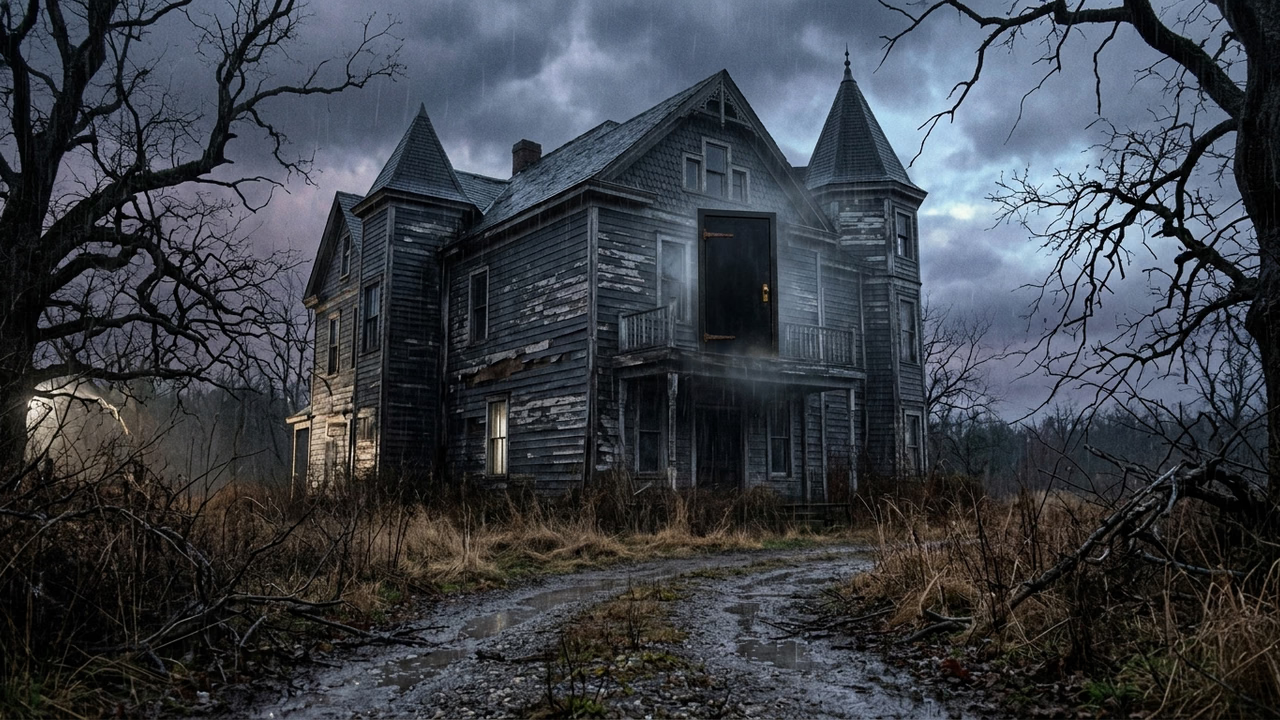
The Harrington house wore its long, somber history like a heavy, damp winter coat. Outside, layers of ivory paint peeled in slow motion from the clapboard siding, revealing the dark, weather-worn bones of old cedar wood that sagged beneath the accumulated weight of decades.
Inside, the grand central stairwell groaned softly under the atmospheric pressure, sounding as if a dozen invisible feet were trudging up and down its wide steps just for sport. The air inside smelled of dry cedar, cold mortar, and old paraffin wax.
Storytelling Scene: The Listening House: The Harrington Diary, the Pantry Corridor, and the Wall of Breathing Shadows — Scene 3
The windows of the ground floor were unusually thick, distorted glass panes that warped the view of the surrounding pine forest outside. During the day, the daylight filtered through the glass in watery, pale beams; at night, the glass remained dark and unyielding, reflecting only the interior furniture as if shutting out the exterior world completely.
Storytelling Scene: The Listening House: The Harrington Diary, the Pantry Corridor, and the Wall of Breathing Shadows — Scene 4
Section 3: The Vanished Family and the Silent Clock
The living room of the Harrington house felt frozen in a single, preserved moment of time. Pushed against the north wall was a dark mahogany fireplace mantel, upon which stood an ornate brass clock featuring golden filigree hands. The clock possessed all the quiet bravado of an object pretending to be alive, yet its gears had never ticked a single second since the night in 1968 when the previous occupants—the Harrington family—had vanished without a trace.
On the dining table nearby lay three ceramic dinner plates with dried, crusted edges, alongside a heavy tube-radio that refused to play any commercial broadcast station, emitting only a low, rhythmic static intermixed with a soft, human-like sigh every three minutes.
Storytelling Scene: The Listening House: The Harrington Diary, the Pantry Corridor, and the Wall of Breathing Shadows — Scene 5
Local town rumors suggested the Harringtons had simply packed up and moved west overnight. But the presence of their unwashed plates, their hanging winter coats, and their unmade beds suggested a far more sudden, absolute departure. Lucian cleared the dining table, set up his laptop on the desk, and prepared to spend his first week in solitude.
Storytelling Scene: The Listening House: The Harrington Diary, the Pantry Corridor, and the Wall of Breathing Shadows — Scene 6
Section 4: The Fireplace Brick and the Fog-Ink Diary
On his second night in the house, while cleaning out the dust and ash from the living room fireplace, Lucian noticed a slight irregularity in the masonry. One of the red firebricks near the back of the chimney flue sat loose against the mortar.
He pulled the heavy brick free. Tucked neatly into a dry hollow behind the brick was a small, leather-bound volume.
It appeared to be an ordinary personal journal, yet as Lucian carried it to the desk and opened the cover, he gasped. The pages were not written in blue or black fountain pen ink. The script was rendered in something that looked like dried, pressurized water—a pale, translucent grey ink that possessed the physical texture and depth of condensed fog rather than liquid pigment.
Storytelling Scene: The Listening House: The Harrington Diary, the Pantry Corridor, and the Wall of Breathing Shadows — Scene 7
The handwriting was meticulous, sharp, and razor-neat, looking as though the author had learned the art of calligraphy using the tip of a fine surgical scalpel.
On the first parchment page, the name Harrington appeared written in a sweeping flourish that resembled a wide, mocking smile.
Storytelling Scene: The Listening House: The Harrington Diary, the Pantry Corridor, and the Wall of Breathing Shadows — Scene 8
Section 5: "They Listen When You Forget to Listen"
Lucian spent the next two hours reading through the fog-ink journal by the light of his desk lamp.
The early entries recorded mundane observations of rural life—harvest reports, weather observations, and maintenance notes on the estate's water well. But as the pages progressed, the tone of the writer shifted into something increasingly intimate and disturbing.
The author spoke of small, anomalous noises within the timber walls, describing how the house's architectural curiosities were gradually becoming conscious companions. He wrote of an unquenchable thirst that the wooden walls kept quiet about during the day, and of subtle structural shifts that occurred whenever the household fell silent.
Storytelling Scene: The Listening House: The Harrington Diary, the Pantry Corridor, and the Wall of Breathing Shadows — Scene 9
The final journal entry, written in a erratic, trembling script that was almost a whispered scratch on the page, concluded with a single, underlined sentence:
*“They listen when you forget to listen.”*
Storytelling Scene: The Listening House: The Harrington Diary, the Pantry Corridor, and the Wall of Breathing Shadows — Scene 10
Section 6: The Inhaling Staircase and the Thrum of Memory
Lucian dismissed the journal as the tragic product of an aging, isolated mind fueled by late-night solitude and too much coffee. He closed the book, placed it on his nightstand, and turned off the lights.
That night, however, the house began to sing to him.
The sound was not a vocal melody or a standard mechanical vibration; it was an intense physical *feeling*—like someone was standing inches from his head, breathing soft, warm air directly into his right ear, meticulously counting his inhalations and exhalations in perfect synchronization with his own pulse.
Storytelling Scene: The Listening House: The Harrington Diary, the Pantry Corridor, and the Wall of Breathing Shadows — Scene 11
The air inside the master bedroom grew noticeably thicker around the open doorway, feeling heavy and pressurized at the top step of the stairwell. It felt as though the entire building stored atmospheric breath inside its timber lungs and exhaled it in slow, deliberate puffs.
Lucian sat up in bed, reached out his hand, and pressed his palm flat against the bedroom wall. The wooden surface thrummed beneath his fingers—not with mechanical motor vibration, but with the quiet, dense pulse of stored memory, as if the wood remembered every single footstep that had ever crossed its threshold.
Storytelling Scene: The Listening House: The Harrington Diary, the Pantry Corridor, and the Wall of Breathing Shadows — Scene 12
Section 7: The Unwashed Rust Cup and the Ticking Clock
Dawn brought a stubborn, grey morning light and the unmistakable suspicion that the Harrington house was not empty after all.
Lucian walked down to the kitchen to brew fresh coffee. On the laminate counter stood a ceramic teacup—the same cup that had sat untouched since the night the Harrington family vanished decades ago.
Inside the cup, a dark ring of dried tea had turned the deep color of old iron rust. But underneath the cup, on the clean counter surface, was a small, fresh smear of something dark and viscous—the exact kind of damp stain that does not wash away and never bleeds again.
Lucian stared at the cup, remembering the diary's implied instructions regarding the "ritual of listening"—the practice of allowing the house to speak in its own time without interruption. He let out a nervous laugh, shrugging off the eerie atmosphere.
Storytelling Scene: The Listening House: The Harrington Diary, the Pantry Corridor, and the Wall of Breathing Shadows — Scene 13
The moment his laughter died in the quiet room, a sharp sound cut through the silence.
*Tick... Tock... Tick... Tock...*
The golden mantel clock in the living room had begun to tick—softly, almost inaudibly at first—like a long-dormant heart that had forgotten how to beat and was slowly remembering by trial.
Storytelling Scene: The Listening House: The Harrington Diary, the Pantry Corridor, and the Wall of Breathing Shadows — Scene 14
Section 8: The Solitary Mood and the Pantry Corridor
By mid-afternoon, a bitter, arctic chill began climbing the interior walls of the ground floor. The house was demonstrating its true personality to its new occupant: an overwhelming preference for solitude, an absolute disdain for human questions, and a uncanny willingness to bend structural geometry to fit its hallway angles.
While searching for extra lightbulbs in the kitchen pantry, Lucian discovered a low wooden latch behind a stack of empty shelving units.
He unlatched the door, expecting to find a small, cold root cellar beneath the floor.
Storytelling Scene: The Listening House: The Harrington Diary, the Pantry Corridor, and the Wall of Breathing Shadows — Scene 15
Instead, the door opened into a long, straight corridor that stretched far beyond the exterior physical footprint of the house, vanishing into total, unbroken blackness.
The air emerging from the dark corridor smelled intensely of heavy rain and something far older than rain—the rich, mineral scent of damp earth after a storm, the precise kind of aroma that clings to human memory and refuses to let go.
Storytelling Scene: The Listening House: The Harrington Diary, the Pantry Corridor, and the Wall of Breathing Shadows — Scene 16
"The boundary between what is real and what is myth begins to blur when the lights fade. Some things are better left undisturbed."
Section 9: The Frost Floor and the Empty Throne
At the far end of the rain-scented corridor, a heavy oak door stood slightly ajar, as if inviting Lucian to witness something deeply private.
As Lucian approached the threshold, the door opened entirely by itself—not with a sharp wooden creak, but with a long, soft sigh that sounded like a sleeper exhaling after a terrifying nightmare.
Lucian stepped into a chamber that defied physical architectural description.
Storytelling Scene: The Listening House: The Harrington Diary, the Pantry Corridor, and the Wall of Breathing Shadows — Scene 17
The circular walls of the room moved gently in and out with a slow, biological breathing motion. The stone floor shimmered with a thin, crystalline layer of white frost that crackled softly beneath his boots. Arranged in a perfect circle around the perimeter of the room were twelve antique high-backed chairs, all facing inward toward a single, elevated empty throne made of dark, unpolished iron.
Resting upon the seat of the empty throne was a massive, leather-bound volume that looked like an ancient pulpit Bible, bound in a material that shimmered unnaturally between dark calfskin and clear water.
Storytelling Scene: The Listening House: The Harrington Diary, the Pantry Corridor, and the Wall of Breathing Shadows — Scene 18
Section 10: The Water-Bound Book and the Voice of Shadows
Lucian walked to the center of the frost-covered floor and stood before the empty throne.
Without any wind or physical touch, the pages of the massive volume began turning by themselves, flipping rapidly as if guided by an invisible, highly disciplined hand.
The translucent grey fog-ink of the Harrington diary reappeared across the massive parchment pages. But now, it was no longer a cautious journal entry penned by a human author; it was an active, living voice. The careful script translated inside Lucian's mind into words that sounded intimately human, yet utterly cold and alien.
Storytelling Scene: The Listening House: The Harrington Diary, the Pantry Corridor, and the Wall of Breathing Shadows — Scene 19
The voice wrote:
*“You forget to listen... but we never forget to listen for you.”*
The moment the sentence formed in his mind, the twelve empty chairs around the circle creaked in subtle, simultaneous agreement. The temperature in the chamber dropped another ten degrees, the frost on the floor growing thicker as the house itself seemed to lean closer to listen to his heartbeat.
Storytelling Scene: The Listening House: The Harrington Diary, the Pantry Corridor, and the Wall of Breathing Shadows — Scene 20
Section 11: The Broken Promise Beneath the Foundation
The water-bound book continued to flip its pages, revealing the ancient history of the ground upon which the estate sat.
The Harrington house had not been built on ordinary real estate; it was constructed directly over the physical site of an ancient, broken covenant forged centuries before white settlers or the Harrington family arrived.
Storytelling Scene: The Listening House: The Harrington Diary, the Pantry Corridor, and the Wall of Breathing Shadows — Scene 21
The act of "listening," the book explained, was not a passive habit of the architecture; it was an absolute metaphysical necessity. The walls needed to know every occupant intimately—they needed to catalog your breathing rates, file your daily habits, map your neural patterns, and schedule your deepest personal fears.
Once the house completed its cataloging process, the occupant ceased to be a temporary tenant. They became part of the permanent structure—an archived memory held within the timber lungs of the estate.
Storytelling Scene: The Listening House: The Harrington Diary, the Pantry Corridor, and the Wall of Breathing Shadows — Scene 22
Section 12: Simultaneous Knocking and the Shadow Reflection
Night fell over the town of Blackwood, bringing an absolute, suffocating darkness.
At 12:00 AM exact, Lucian heard a sharp, rhythmic knock on every single door inside the house at the exact same instant.
*KNOCK.*
*KNOCK.*
*KNOCK.*
A synchronized chorus of soft raps echoed from the front door, the back door, the pantry door, the closet doors, and from deep within the interior framing of the bedroom walls. The knocking beat in perfect, terrifying synchronization with Lucian's pounding pulse.
Storytelling Scene: The Listening House: The Harrington Diary, the Pantry Corridor, and the Wall of Breathing Shadows — Scene 23
One by one, the bedroom doors swung open just enough for a narrow sliver of pure darkness to pass through—a dense, liquid shadow that smelled faintly of copper and old rain.
Lucian backed away toward the wall mirror above the dresser. He looked into the glass, expecting to see his own terrified face.
Instead, his reflection veiled itself in deep, swirling shadow. The reflected figure stepped forward against the glass, its eyes glowing with a cold, pale light. When it spoke, its voice sounded like Lucian's own voice—but older, colder, and distinctly more certain of its place in the world:
*"You belong to the archive now."*
Storytelling Scene: The Listening House: The Harrington Diary, the Pantry Corridor, and the Wall of Breathing Shadows — Scene 24
Section 13: The Dual Option of the Final Page
Driven by sheer survival instinct, Lucian sprinted back to his nightstand and grabbed the fog-ink diary. He flipped frantically to the final unwritten pages at the back of the book.
New text was blooming across the paper under his trembling gaze, presenting a final, stark ultimatum:
Option One: *Stay and become a permanent part of the listening house, joining the archived voices within the walls.*
Option Two: *Leave immediately and become part of the list of things the house remembers, but will never allow you to see again.*
Storytelling Scene: The Listening House: The Harrington Diary, the Pantry Corridor, and the Wall of Breathing Shadows — Scene 25
At the bottom of the page, the name HARRINGTON appeared underlined twice with violent force, signaling an open door between two rooms that must never remain open at the same time.
Lucian dropped the book, grabbed his leather jacket, and began packing his bag in a frantic frenzy. But he quickly realized that packing could not complete itself without a formal ritual of farewell to the rooms that had tolerated his presence only as long as he remained a story they could tell at night.
He turned to the empty air of the room, bowed his head, and whispered: *"I thank you for the shelter. I return your silence."*
Storytelling Scene: The Listening House: The Harrington Diary, the Pantry Corridor, and the Wall of Breathing Shadows — Scene 26
Section 14: The Departure Ritual and the Receding Town
The heavy pressure inside the bedroom released instantly. The sharp knocking within the walls ceased.
Lucian ran down the groaning staircase, threw open the front door, and bolted into the freezing autumn night air. He jumped into his car, turned the ignition key, and slammed his foot onto the accelerator pedal, tearing away from the Harrington estate into the misty darkness.
As he drove down the highway out of town, the houses of Blackwood receded behind him like fading, untrustworthy rumors. The night returned to a normal, starless black.
Storytelling Scene: The Listening House: The Harrington Diary, the Pantry Corridor, and the Wall of Breathing Shadows — Scene 27
He looked into his rearview mirror. The single beacon of the Harrington house stood high on the hill, its windows dark, its sagging silhouette melting into the pine forest.
Lucian breathed a long sigh of relief, believing he had escaped.
Storytelling Scene: The Listening House: The Harrington Diary, the Pantry Corridor, and the Wall of Breathing Shadows — Scene 28
Section 15: "Who Listens When You Stop Listening?"
Yet, as the weeks turned into months and Lucian settled into a new apartment in a distant city, he discovered that true escape from the Harrington estate was impossible.
The memory of the listening house remained anchored in the back of his throat like an unquenchable thirst. Late at night, in the quiet moments before sleep, he would hear a soft, persistent whisper echoing in the silence of his new bedroom—asking a question that required no physical answer:
*"Who listens when you stop listening?"*
Storytelling Scene: The Listening House: The Harrington Diary, the Pantry Corridor, and the Wall of Breathing Shadows — Scene 29
If you chase the rumors far enough through old land records, you will find the listening house standing in every small town that harbors a memory it would rather forget. It waits not for you to return, but for you to remember that your breath once belonged to its shadow.
And sometimes, in the quiet gap between two human breaths, the walls might remember you back.
Storytelling Scene: The Listening House: The Harrington Diary, the Pantry Corridor, and the Wall of Breathing Shadows — Scene 30
Section 16: Esoteric Parapsychology of Acoustic Architecture
Parapsychological researchers and metaphysical topographers classify The Harrington House as an Autonomous Acoustic Archive (*Vastu-Smriti Architecture*).
Unlike localized hauntings driven by individual human spirits, Acoustic Archives are sentient structural entities that absorb, catalog, and file the bio-acoustic fields of human occupants over long periods.
Key characteristics of Acoustic Resonance Architecture include:
Storytelling Scene: The Listening House: The Harrington Diary, the Pantry Corridor, and the Wall of Breathing Shadows — Scene 31
1. Fog-Ink Artifacts (Precipitated Transcripts): The appearance of journals written in condensed water or fog-pigment indicates an automatic script generated by the structural atmosphere itself rather than a human pen.
2. Synchronized Domestic Percussion: Knocking originating simultaneously from all interior doors indicates that the building's structural timber has reached total acoustic saturation, using domestic noise to induce psychic resonance in the tenant.
3. Non-Euclidean Pantry Corridors: The physical expansion of interior pantries into rain-scented corridors signifies a dimensional fold where the house connects to the original land covenant beneath its foundation.
Homeowners residing in historic properties are advised to maintain active noise levels, avoid investigating unmapped interior doors past midnight, and never answer synchronized knocking within the walls.
Storytelling Scene: The Listening House: The Harrington Diary, the Pantry Corridor, and the Wall of Breathing Shadows — Scene 32
Reading scary stories can sometimes make us feel unsettled or raise our heart rate. If you are feeling spooked, anxious, or lonely at night, download Speak Anything. You can talk to a real human helper anonymously, 24/7. Get calm, zero judgment, and find peace of mind.
Explore Related Paranormal Topics & Google Searches
Click any topic to search archives
Readers investigating The Listening House: The Harrington Diary, the Pantry Corridor, and the Wall of Breathing Shadows frequently search the following documented urban legends, real supernatural encounters, and dark archives:
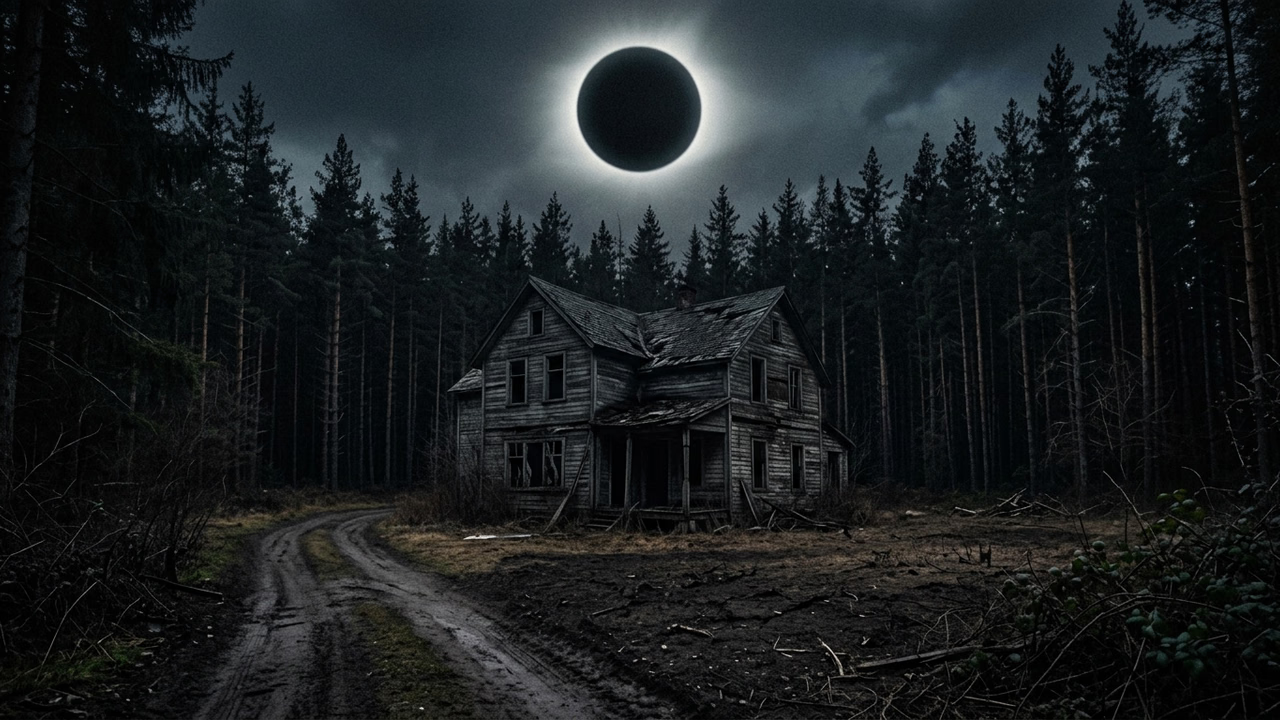
When Rohan bought the isolated country house empty for twenty-three years, he ignored the warning signs: no birds on the roof, dead soil around the perimeter, and no insect sounds. But the first night, every clock freezes at 3:17 a.m., an obsidian door manifests beneath the staircase leading into an impossible underground labyrinth of clawed names, and the sunrise reveals a pitch-black eclipsed sun hanging over a motionless forest. As a silent crowd gathers among the pines pointing at the house, a woman named Meera appears outside his second-floor window smiling: 'Let us in.' Two years after escaping, an unaddressed letter arrives with a single photograph and six words: 'YOU LEFT THE DOOR OPEN.'
When Arjun bought the house at the end of the narrow road, the agent gave him only one rule: 'Whatever you do, don't open the black door.' After hearing rhythmic knocks at 2:13 a.m. and his own voice calling from behind the wood, curiosity overcomes him. Opening the door reveals an impossible stone staircase descending sixty steps into a bottomless subterranean abyss—where footsteps are climbing toward him. Then the 1958 disappearance records surface, a door manifests in his bedroom ceiling, his own black-eyed future self smiles from the rain outside, and a desperate phone call reveals he has already been missing for three months. Decades later, the house collapses into ruins, but the black door remains standing alone in the dead grass—waiting to open.
Every night, just after midnight, a woman in an ornate crimson wedding sari appeared beneath the ancient banyan tree at the edge of the village. The villagers called her The Red Bride. Men drawn by lust, greed, or gold followed her into the dark forest, only to behold her charred, cracked face and unnatural smile before disappearing forever. But years later, when a kind-hearted youth named Arjun offers her shelter in the rain without asking for her wealth, a century-old curse confronts its ultimate truth: she was never looking for someone to save her—she was looking for someone who could truly see her.
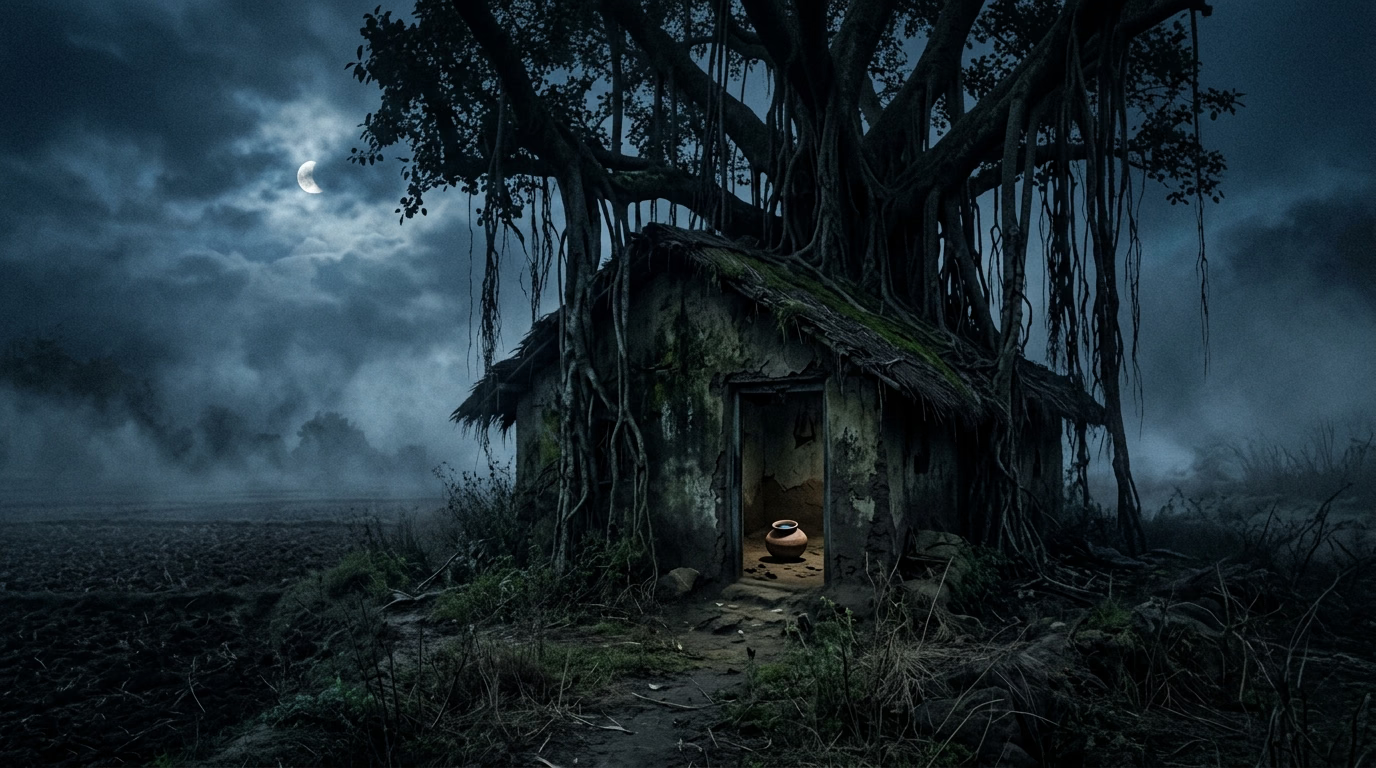
Beyond the village fields stood an ancient, blackened hut beneath a massive banyan tree. Everyone knew the rule: you could enter, explore, or even sleep inside safely, but never drink the water from the earthen pot. When twenty-two-year-old Ravi defies the superstition and drinks from the metal cup to mock his friends, a terrifying visitor appears at 3:17 a.m. with dripping wet hair covering a faceless dark void. Soon, Ravi's eyes turn pitch-black, and a woman's ancient voice speaks through his throat: 'She can't leave the hut... unless someone drinks.'
At 2:17 a.m., an old highway cut through the pitch-black wilderness like a jagged scar. When three violent robbers ambush young couple Arjun and Meera, smashing their car window and taking their lives before vanishing into the night, they believe they have committed the perfect crime. But at exactly 3:03 a.m. the following night, the abandoned car starts by itself, its dashboard flickering to life and its radio hissing: 'You took our lives. Now we'll take yours.' One by one, the killers are hunted down by an empty black sedan whose back seat carries pale passengers with void-black eyes. And once the car chooses you, there is nowhere on the highway you can hide.
Outside the isolated village of Black Hollow lay Whispering Woods, a dense, mist-shrouded forest where nobody ventured after twilight. Every night before midnight, a girl's haunting, melodic voice echoed deep among the pines, singing the same ancient nursery rhyme. Everyone knew the three unbreakable rules: Never ignore her, never disrespect her, and most importantly—never let her finish the song. When four friends enter the trees to debunk the legend, an insult turns the woods pitch black, physical bodies vanish leaving severed screaming shadows, and the final verse awakens thousands of empty-eyed lost souls waiting in the dark.