September 8, 2026•15 min read•By Paranormal Medical Archives & Hospital Urban Legend Desk
Audio Narrator
Listen to Horror Story Audio
SCENE 1 — THE MIDNIGHT EMERGENCY CALL & THE SEALED FOURTH FLOOR
The Operation Room That Never Closed — Scene 1: The Midnight Call & The Flickering Fourth Floor Corridor
At 2:13 a.m., the landline in the on-call doctors' quarters rang with a sharp, piercing trill that cut through the dead silence of City General Hospital.
Dr. Arjun Mehta bolted awake. His heart was racing before his hand even reached the receiver. In a trauma center, middle-of-the-night calls were routine, but there was something singularly discordant about the cadence of this ring—jagged, persistent, vibrating straight into the plaster wall.
He lifted the handset to his ear.
"**DR. ARJUN MEHTA** "
"*"Mehta speaking. What's the emergency?"*"
The voice that answered was low, breathy, and distorted by intense analog static—the kind of hollow hiss heard only on ancient copper lines:
"**NURSE ON CALL** "
"*(hurried, trembling whisper)* "
"*"Doctor... we need you in Operation Theatre 4. Right now."*"
Arjun frowned, sitting upright on the edge of the cot and rubbing the exhaustion from his eyes.
"**DR. ARJUN MEHTA** "
"*"OT 4? That's impossible. OT 4 has been padlocked and decommissioned since before I started my residency. I thought it was completely sealed."*"
There was a long, suffocating silence on the other end of the line.
The background noise wasn't the usual hum of modern telemetry or the sterile chime of infusion pumps. It sounded like dripping water echoing against hollow ceramic tiles, followed by the faint, rhythmic metallic clink of surgical steel against stainless trays.
Then the nurse whispered, her tone brittle as thin ice:
"**NURSE ON CALL** "
"*"It has been reopened."*"
Click.
The line went dead.
Arjun pulled on his white coat, grabbed his stethoscope, and stepped out into the stairwell. The hospital elevators were grounded on the ground floor for maintenance, forcing him to take the concrete stairs up to the fourth floor.
The fourth floor of City General had been largely abandoned after the restructuring in 2006. As Arjun pushed open the heavy fire doors, the transition was jarring. Downstairs on the second and third floors, warm LED lighting and bustling night nurses gave the hospital a semblance of modern life. Here, the corridor was plunged into cold, green-tinged shadows.
The only illumination came from long fluorescent tubes overhead that hummed with a sick, dying vibration, flickering rhythmically against the peeling wall paint.
The air smelled distinct and suffocating—not the fresh antiseptic alcohol of a modern hospital wing, but an acrid cocktail of carbolic acid, old dust, and copper-rich dried blood.
Arjun walked slowly down the linoleum corridor. His footsteps produced no echo; the silence seemed to absorb every frequency.
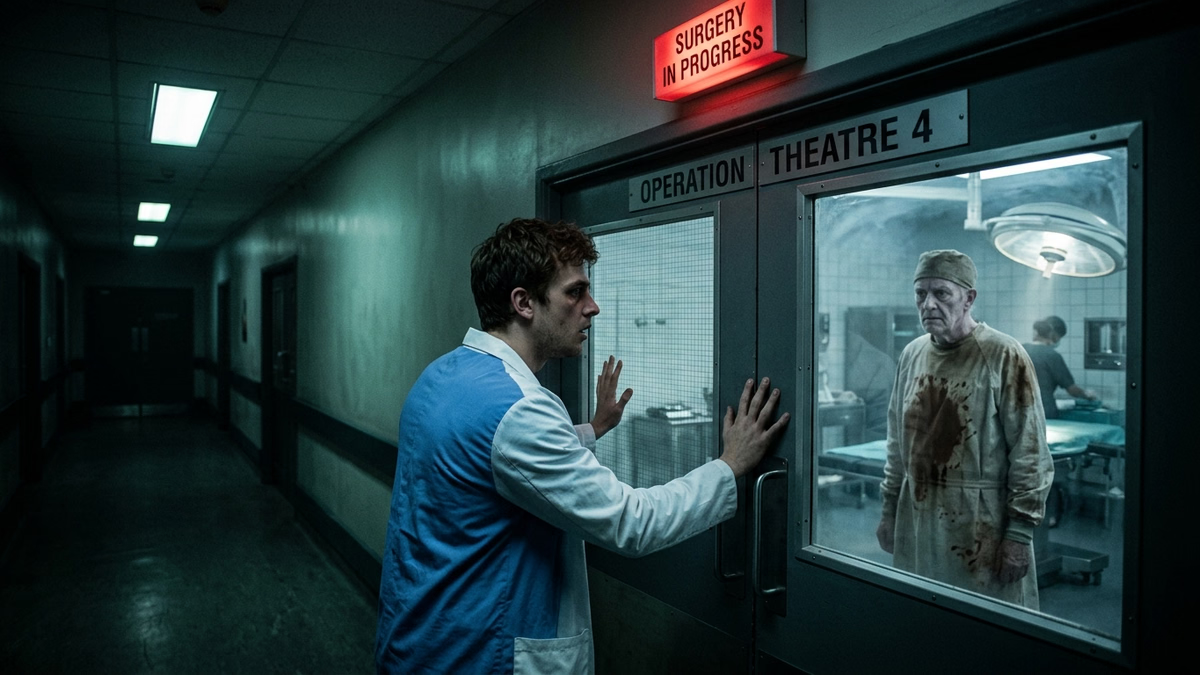
At the far end of the hallway stood the heavy double metal doors of Operation Theatre 4.
The warning box above the lintel was already ablaze with an intense, bloody crimson neon:
`S U R G E R Y I N P R O G R E S S`
Arjun stopped three paces short of the threshold, his breath catching in his throat.
"**DR. ARJUN MEHTA** "
"*(calling out down the corridor)* "
"*"Hello? Who is operating in 4 tonight?!"*"
Nobody answered. Only the low electrical buzz of the illuminated sign replied.
Arjun took a deep breath, extended his hand, and pushed the swinging metal doors open.
SCENE 2 — THE FREEZING THEATRE & DR. VIKRAM RAO’S RETURN
The Operation Room That Never Closed — Scene 2: The Freezing Theatre & Dr. Vikram Rao
The instant Arjun crossed the threshold, a blast of sub-zero air slammed into his chest.
It was freezing—unnatural, bone-chilling cold that instantly crystallized the breath billowing from his mouth and nostrils. A thin sheen of white frost clung to the edges of the stainless steel instrument tables, the metal kick-buckets, and the glass cabinets lining the tiled walls.
Suspended from the ceiling, the massive circular domed surgical light beam poured a blinding cone of harsh white glare directly onto the center of the room.
Beneath the spotlight lay the operating table.
A patient lay motionless beneath a heavy surgical drape. The sheet covered the figure from head to toe, outlining a stiff, motionless human form.
Beside the bed sat an antique CRT cardiac monitor—a heavy, olive-green metal console that had been out of production for decades. Its cathode-ray tube screen cast an eerie emerald glow over the floorboards.
A perfectly steady green line stretched across the glass screen, pulsing with agonizing, mechanical regularity:
`Beep.`
`Beep.`
`Beep.`
Arjun stepped forward, his leather shoes squeaking against the icy floor tiles. Every medical instinct inside him urged caution, but duty compelled him toward the table.
"**DR. ARJUN MEHTA** "
"*"Where is the scrub nurse? Where is the surgical team? Why isn't the patient prepped?!"*"
From the dim, shadowed corner behind the anesthesiology station, a dry, rasping voice spoke:
"**VOICE IN THE SHADOWS** "
"*"I'm still here, Doctor."*"
Arjun's entire body seized.
He turned slowly on his heels.
Standing in the corner, just beyond the perimeter of the overhead lamp, was an elderly surgeon.
The man wore an antique, faded cloth surgical gown—the kind tied with cloth strings at the back, completely stiffened and discolored by decades of dark, dried arterial blood. His matching cotton cap was stained yellow around the brow, and over his mouth hung a sagging gauze mask.
Above the mask, two sunken, hollow eyes stared directly into Arjun's face.
Arjun's heart slammed violently against his ribs. The recognition was instantaneous and paralyzing.
Every junior resident at City General was shown the hospital's historical archive wall in the main lobby. On the wall hung a black-and-white portrait of the hospital's legendary chief of thoracic surgery from the 1990s:
Dr. Vikram Rao.
Twenty years ago, in the autumn of 2006, Dr. Rao had locked himself inside Operation Theatre 4 during an unscheduled midnight emergency surgery. The patient had died on the table under disputed circumstances, and before the authorities could breach the steel security deadbolts, Dr. Rao had suffered a fatal massive cerebral hemorrhage directly over the open incision.
The hospital board had permanently sealed OT 4 the following morning to bury the scandal and the lawsuit that followed.
"**DR. ARJUN MEHTA** "
"*(voice trembling, stepping back)* "
"*"That's impossible... Dr. Rao died twenty years ago. You died in this room."*"
Dr. Rao's dry, cracked lips pulled back behind the gauze mask into a calm, sickeningly wide smile. His eyes gleamed with unnatural, predatory patience.
"**DR. VIKRAM RAO** "
"*(hollow, dual-toned whisper)* "
"*"We have been waiting for you, Arjun."*"
Before Arjun could scream or turn toward the exit, the overhead surgical lights flared with a blinding, deafening pop of blue electrical sparks—and detonated.
The operating theatre was plunged into total, absolute blackness.
"The boundary between what is real and what is myth begins to blur when the lights fade. Some things are better left undisturbed."
SCENE 3 — THE SCREAMING MONITOR & THE DOPPELGÄNGER CORPSE
The Operation Room That Never Closed — Scene 3: The Screaming Monitor & The Living Corpse
For five agonizing seconds, Arjun stood frozen in the pitch-dark, listening to nothing but his own ragged, terrified panting.
Then, with a dull hydraulic hum, the auxiliary emergency circuits kicked in. The dim overhead strip light flickered back to life, casting a sickly chartreuse haze across the room.
Arjun whipped his head around.
The corner was empty. Dr. Rao had vanished without a trace.
He looked toward the center of the theatre.
The operating table was bare. The motionless draped figure was gone. The chrome stirrups and leather restraints hung slack.
Arjun lunged backward toward the double metal doors, his palms slamming against the push-bars:
`C L A N G . C L A N G .`
The doors wouldn't budge.
The exterior magnetic fire latches had locked into place. The reinforced glass windows in the door panels were pitch black, as though the corridor outside had ceased to exist.
Then, from the stainless cart behind him, the old cardiac monitor began screaming.
Not a rhythmic pulse. Not an alert tone.
A continuous, ear-splitting, unbroken electronic shriek:
`B E E E E E E E E E E E E P .`
The green beam on the phosphor screen had flattened into a solid, unmoving line.
And beneath the flatline, pixel by pixel, glowing green block letters burned into the glass:
`PATIENT: ARJUN MEHTA`
`STATUS: FATAL ARREST`
`ROOM: OT 4`
Arjun stared at the monitor, his breath tearing through his throat in shallow gasps:
"**DR. ARJUN MEHTA** "
"*"No... no, no! That isn't my name! I'm the doctor! I'm alive!"*"
Behind him, the air temperature plummeted another twenty degrees.
A heavy, ice-cold hand dropped onto his left shoulder.
The grip was ironclad. Through the thin cotton of his scrub shirt, Arjun could feel five individual fingers, stiff with rigor mortis, pressing into his collarbone with crushing force.
His neck muscles locked in terror. Slowly, agonizingly, Arjun forced himself to turn his head.
Sitting upright on the edge of the operating table was the patient.
The white cotton sheet had slid down to its lap, exposing a pale, bare torso bearing the jagged, black-stitched autopsy scar of a median sternotomy.
The corpse lifted its head.
Arjun's soul withered inside his chest.
It was his own face.
The corpse possessed Arjun's features—the same jawline, the same mole beneath the right cheekbone, the same tousled black hair.
But the skin was ashen gray, cold as river stone. Its lips were swollen and tinged with cyanotic blue. And its dark eyes were pulled open impossibly wide, unblinking, reflecting the green glow of the screaming heart monitor.
The corpse leaned slowly forward, its jaw unhinging with a sickening wet click of cartilage.
From its dead throat drifted a cold, sulfurous breath that smelled of embalming fluid and decay, murmuring in a voice that was undeniably Arjun's own:
"**THE CORPSE** "
"*(suffocating, rasping whisper)* "
"*"Doctor... you are late."*"
Arjun opened his mouth to shriek, but the air froze in his lungs.
The corpse's freezing gray hands reached out, clamping onto his wrists with bone-snapping intensity. The screaming flatline rose to a pitch that shattered the glass bottles on the medication shelves.
Darkness rushed into Arjun's vision like black ink spilled across paper. His knees folded beneath him, and his head struck the concrete floor.
SCENE 4 — THE 72-HOUR COMA & THE 2:13 A.M. RECURRENCE
The Operation Room That Never Closed — Scene 4: The 2:13 AM Nightly Surgical Ritual
At 6:30 a.m. the following morning, the day-shift cleaning crew noticed that the heavy rusted chain securing the outer handles of Operation Theatre 4 had been sheared clean through.
When the head nurse cautiously pushed the double doors open, they found Dr. Arjun Mehta collapsed in the center of the freezing theatre.
He was lying face-down in front of the empty operating table, his core body temperature dropped to a critical 31 degrees Celsius (87.8°F). He was in deep hypothermic shock, his fingers curled into stiff claws, completely unresponsive.
Beside him, the ancient cardiac monitor was unplugged from the wall outlet—covered in an undisturbed three-decade layer of grime and cobwebs.
Arjun was rushed to the Intensive Care Unit on the third floor.
For seventy-two hours, he remained in a deep, unresponsive coma. His vitals fluctuated wildly, his brain scans showing intense, erratic activity concentrated in the fear centers of the amygdala, as though his consciousness was trapped in an endless, looping nightmare.
On the morning of the fourth day, Arjun opened his eyes.
He looked around the bright, sunlit ICU room with empty confusion.
When the chief medical officer questioned him about what had happened on the fourth floor, Arjun shook his head blankly:
"**DR. ARJUN MEHTA** "
"*(quiet, bewildered)* "
"*"I remember finishing my evening rounds on Tuesday at 10:00 p.m. I lay down on the call-room cot. The next thing I knew, I woke up here with an IV in my arm."*"
He remembered nothing of the phone call.
He remembered nothing of the open door, the bloodied gown, the screaming monitor, or his own dead face.
The hospital management, eager to avoid scandal, declared the incident a severe episode of exhaustion-induced sleepwalking complicated by acute hypothermia. After a mandatory two-week psychiatric evaluation, Arjun returned to his surgical duties.
To all outward appearances, Dr. Arjun Mehta was completely normal. He performed surgeries with immaculate precision, spoke politely to colleagues, and never complained of fatigue.
Yet within the hospital walls, the fourth floor took on a sinister life of its own.
The nursing staff began whispering among themselves during the graveyard shifts.
Every single night, with terrifying, clockwork punctuality at exactly 2:13 a.m., the fourth floor went dead quiet.
The elevator would refuse to stop on the fourth floor. The corridor surveillance cameras would flicker with static interference.
And at the end of the long dark hallway, the red light above Operation Theatre 4 clicked on.
`S U R G E R Y I N P R O G R E S S`
From the far end of the ward, night nurses on the third floor reported hearing the faint, rhythmic sound of an analog cardiac monitor drifting through the central ventilation shafts:
`Beep.`
`Beep.`
`Beep.`
And through the wired observation glass in the heavy metal doors, anyone who dared peer down the hallway could clearly see two dark, elongated shadows moving back and forth beneath the surgical light.
One surgeon standing tall over the table.
One patient lying motionless beneath the scalpel.
For six months, no doctor, nurse, or orderly dared set foot on the fourth floor after midnight. The wing was designated an off-limits biohazard storage area.
The mystery remained sealed behind the reinforced doors—until a man who knew nothing of the hospital's history was assigned to the night patrol.
SCENE 5 — THE SECURITY GUARD’S VIGIL & “SURGERY COMPLETE”
The Operation Room That Never Closed — Scene 5: The Security Guard & The Bloodied Finger
Manoj Kumar was fifty-two years old, an ex-army night watchman who had started working for the hospital's contracted security firm only three days prior.
He had not been briefed on the rumors. He had not heard the whispers about OT 4.
On a rainy Thursday night, at 2:10 a.m., Manoj was completing his routine building rounds with a heavy rubber flashlight in hand. He walked up the stairwell to check the fire exit doors on the fourth floor.
As he entered the fourth-floor corridor, the hallway was freezing.
His warm breath blossomed into thick white mist in the dim air.
At 2:13 a.m., an electric snap echoed down the hall:
`CLICK.`
Above the double doors at the end of the corridor, the red warning light illuminated, casting a vivid scarlet sheen over the reflective linoleum floor:
`S U R G E R Y I N P R O G R E S S`
Manoj frowned, adjusting his utility belt. The floor was supposed to be vacant storage. He assumed unauthorized trespassers or vagrants had broken into the abandoned theatre.
He walked cautiously down the hall, his boots clicking softly against the floor.
He reached the heavy metal doors of Operation Theatre 4.
He leaned forward, cupping both hands against the rectangular wire-glass observation window, and aimed his flashlight beam into the room.
The interior was flooded with harsh, sterile light from the overhead surgical dome.
The air inside was thick with swirling frost.
Standing directly beside the operating table was a surgeon dressed in full surgical scrubs, cloth cap, and rubber gloves.
The front of the surgeon's green gown was drenched in fresh, dark crimson blood. In his right hand, he held a long, silver surgical scalpel, its polished edge dripping thick red droplets onto the tiled floor.
Manoj stared through the glass, his breath caught in his throat.
He recognized the surgeon immediately:
It was Dr. Arjun Mehta.
Manoj's chest tightened. Why was Dr. Mehta performing surgery in a decommissioned ward without an anesthesiologist or an assistant?
Then Manoj shifted his flashlight beam slightly lower, illuminating the figure lying flat upon the metal operating table.
The patient was an elderly man with gray hair, dressed in an antique hospital gown.
The patient's chest had been cleanly cut open in an emergency surgical procedure.
Manoj leaned closer against the glass, his eyes widening in primal dread as he recognized the face on the table.
He had seen that exact face every day in the security office—on the faded newspaper clipping pinned to the bulletin board warning guards about historical incidents on the fourth floor:
It was Dr. Vikram Rao.
The dead surgeon who had perished in 2006 was lying beneath the knife.
And operating upon him was the living doctor who had entered the room six months earlier.
Manoj backed away from the glass in terror, his boots scraping the floor.
Inside the theatre, the surgeon froze.
Dr. Arjun Mehta slowly stopped what he was doing.
Without moving his shoulders, Arjun slowly turned his head toward the observation window.
His face was illuminated by the cold glare of the overhead surgical light.
Arjun looked directly into Manoj's eyes through the plate glass.
His eyes were completely, terrifyingly void-black—the pupils dilated to the very edges of the irises, bottomless pools of absolute dark with no human soul behind them.
A slow, serene, chilling smile spread across Arjun's blood-flecked lips.
He did not speak.
He did not blink.
Slowly, deliberately, Arjun raised his gloved, blood-covered right index finger to his mouth, pressing it against his lips in an eternal, horrifying gesture:
“Shhh…”
The instant the whisper touched Manoj's ears through the solid door—
`B Z Z Z Z T .`
The surgical lamp inside detonated into a shower of white sparks.
The red warning light above the lintel flickered violently three times and died.
For one split second in the sudden pitch-blackness, the green lettering of the exit panel illuminated above the door frame:
`S U R G E R Y C O M P L E T E .`
When the morning shift security team arrived at 6:00 a.m., they found Manoj trembling on the staircase landing, clutching his flashlight, unable to speak a single coherent sentence.
The doors to Operation Theatre 4 were locked from the inside.
When hospital maintenance forced the hinges open, the theatre was completely empty.
No instruments. No blood. No footprints.
Only a thick layer of undisturbed dust, and a single word scratched into the frost on the stainless operating table:
`N E X T .`
And tomorrow night, when the digital clocks across City General strike 2:13 a.m., the red light above the door will turn on once again.
Reading scary stories can sometimes make us feel unsettled or raise our heart rate. If you are feeling spooked, anxious, or lonely at night, download Speak Anything. You can talk to a real human helper anonymously, 24/7. Get calm, zero judgment, and find peace of mind.
Explore Related Paranormal Topics & Google Searches
Click any topic to search archives
Readers investigating The Operation Room That Never Closed frequently search the following documented urban legends, real supernatural encounters, and dark archives:
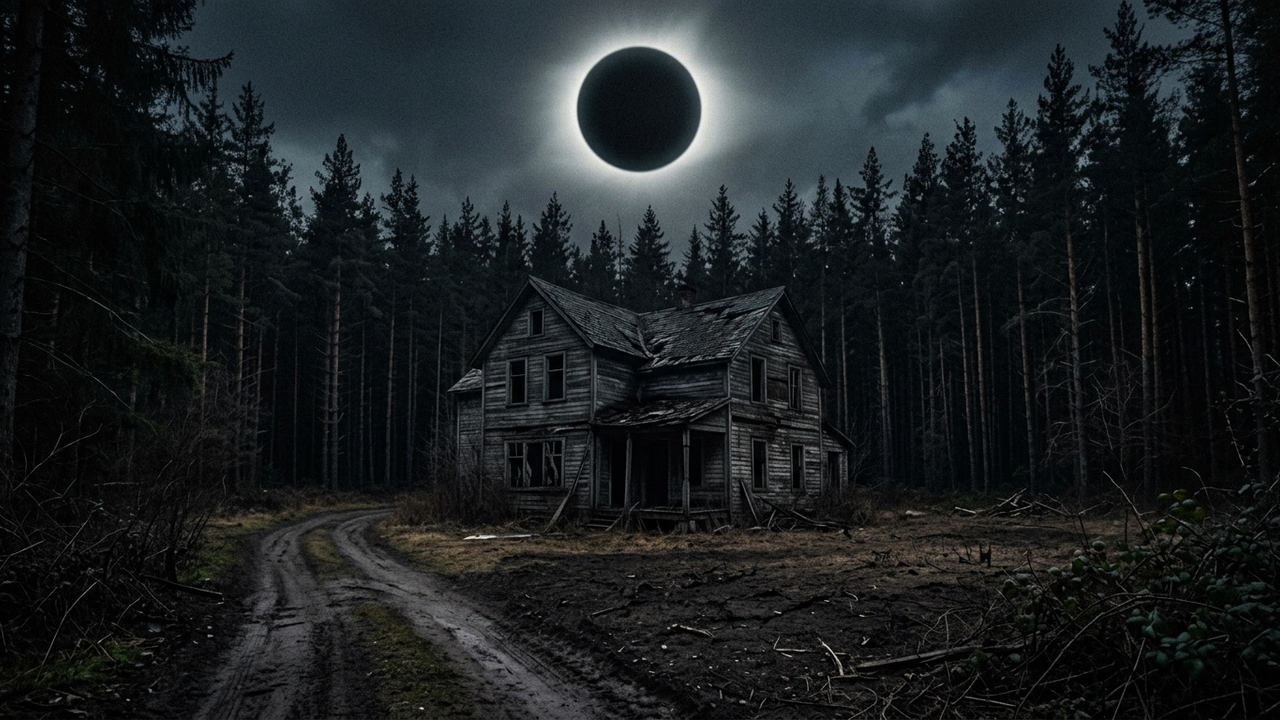
When Rohan bought the isolated country house empty for twenty-three years, he ignored the warning signs: no birds on the roof, dead soil around the perimeter, and no insect sounds. But the first night, every clock freezes at 3:17 a.m., an obsidian door manifests beneath the staircase leading into an impossible underground labyrinth of clawed names, and the sunrise reveals a pitch-black eclipsed sun hanging over a motionless forest. As a silent crowd gathers among the pines pointing at the house, a woman named Meera appears outside his second-floor window smiling: 'Let us in.' Two years after escaping, an unaddressed letter arrives with a single photograph and six words: 'YOU LEFT THE DOOR OPEN.'
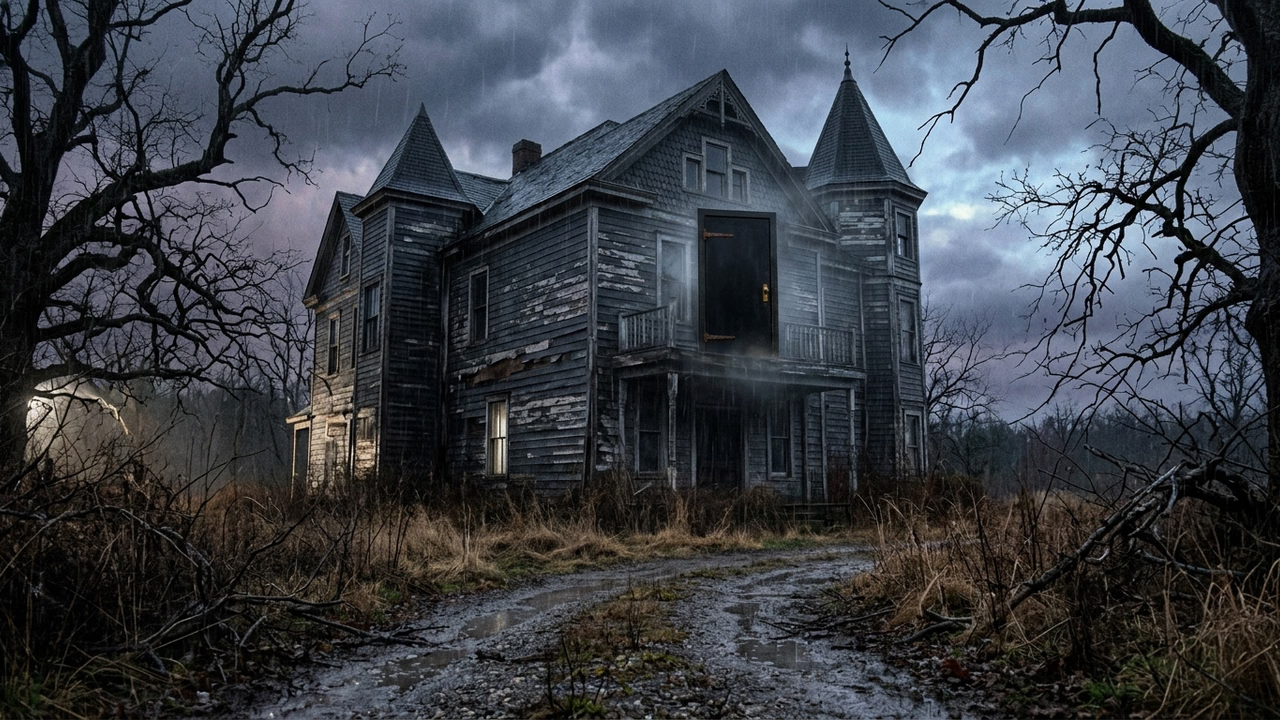
When Arjun bought the house at the end of the narrow road, the agent gave him only one rule: 'Whatever you do, don't open the black door.' After hearing rhythmic knocks at 2:13 a.m. and his own voice calling from behind the wood, curiosity overcomes him. Opening the door reveals an impossible stone staircase descending sixty steps into a bottomless subterranean abyss—where footsteps are climbing toward him. Then the 1958 disappearance records surface, a door manifests in his bedroom ceiling, his own black-eyed future self smiles from the rain outside, and a desperate phone call reveals he has already been missing for three months. Decades later, the house collapses into ruins, but the black door remains standing alone in the dead grass—waiting to open.
Every night, just after midnight, a woman in an ornate crimson wedding sari appeared beneath the ancient banyan tree at the edge of the village. The villagers called her The Red Bride. Men drawn by lust, greed, or gold followed her into the dark forest, only to behold her charred, cracked face and unnatural smile before disappearing forever. But years later, when a kind-hearted youth named Arjun offers her shelter in the rain without asking for her wealth, a century-old curse confronts its ultimate truth: she was never looking for someone to save her—she was looking for someone who could truly see her.
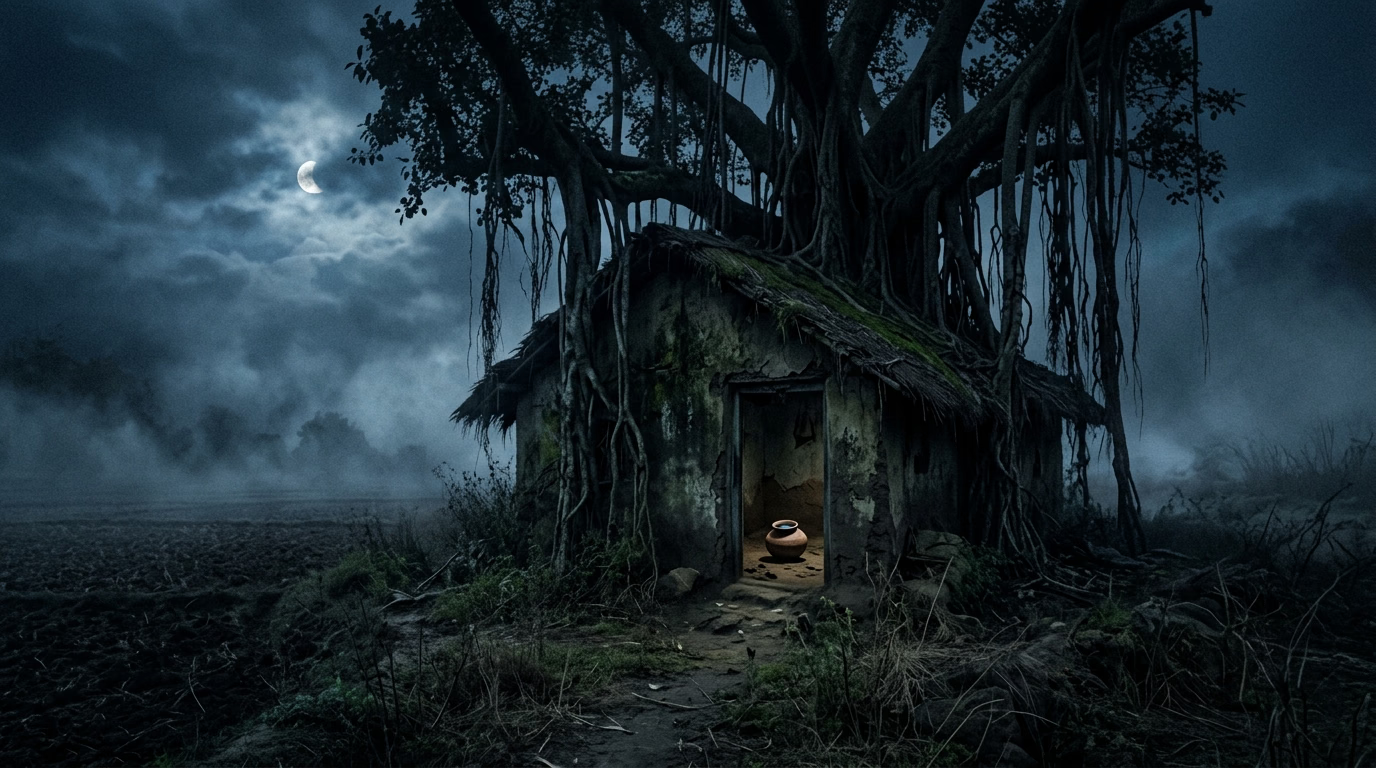
Beyond the village fields stood an ancient, blackened hut beneath a massive banyan tree. Everyone knew the rule: you could enter, explore, or even sleep inside safely, but never drink the water from the earthen pot. When twenty-two-year-old Ravi defies the superstition and drinks from the metal cup to mock his friends, a terrifying visitor appears at 3:17 a.m. with dripping wet hair covering a faceless dark void. Soon, Ravi's eyes turn pitch-black, and a woman's ancient voice speaks through his throat: 'She can't leave the hut... unless someone drinks.'
At 2:17 a.m., an old highway cut through the pitch-black wilderness like a jagged scar. When three violent robbers ambush young couple Arjun and Meera, smashing their car window and taking their lives before vanishing into the night, they believe they have committed the perfect crime. But at exactly 3:03 a.m. the following night, the abandoned car starts by itself, its dashboard flickering to life and its radio hissing: 'You took our lives. Now we'll take yours.' One by one, the killers are hunted down by an empty black sedan whose back seat carries pale passengers with void-black eyes. And once the car chooses you, there is nowhere on the highway you can hide.
Outside the isolated village of Black Hollow lay Whispering Woods, a dense, mist-shrouded forest where nobody ventured after twilight. Every night before midnight, a girl's haunting, melodic voice echoed deep among the pines, singing the same ancient nursery rhyme. Everyone knew the three unbreakable rules: Never ignore her, never disrespect her, and most importantly—never let her finish the song. When four friends enter the trees to debunk the legend, an insult turns the woods pitch black, physical bodies vanish leaving severed screaming shadows, and the final verse awakens thousands of empty-eyed lost souls waiting in the dark.