September 13, 2026•17 min read•By Rajasthan Rural Paranormal Investigation File & District Police Archive #AH-409
Audio Narrator
Listen to Horror Story Audio
SCENE 1 — THE PLACE THAT WAITS & RAJA HARISH SINGH
The Horror of the Abandoned Haveli — Scene 1: The Crumbling Haveli Entrance
There are places that feel empty.
And then there are places that feel as if they are waiting.
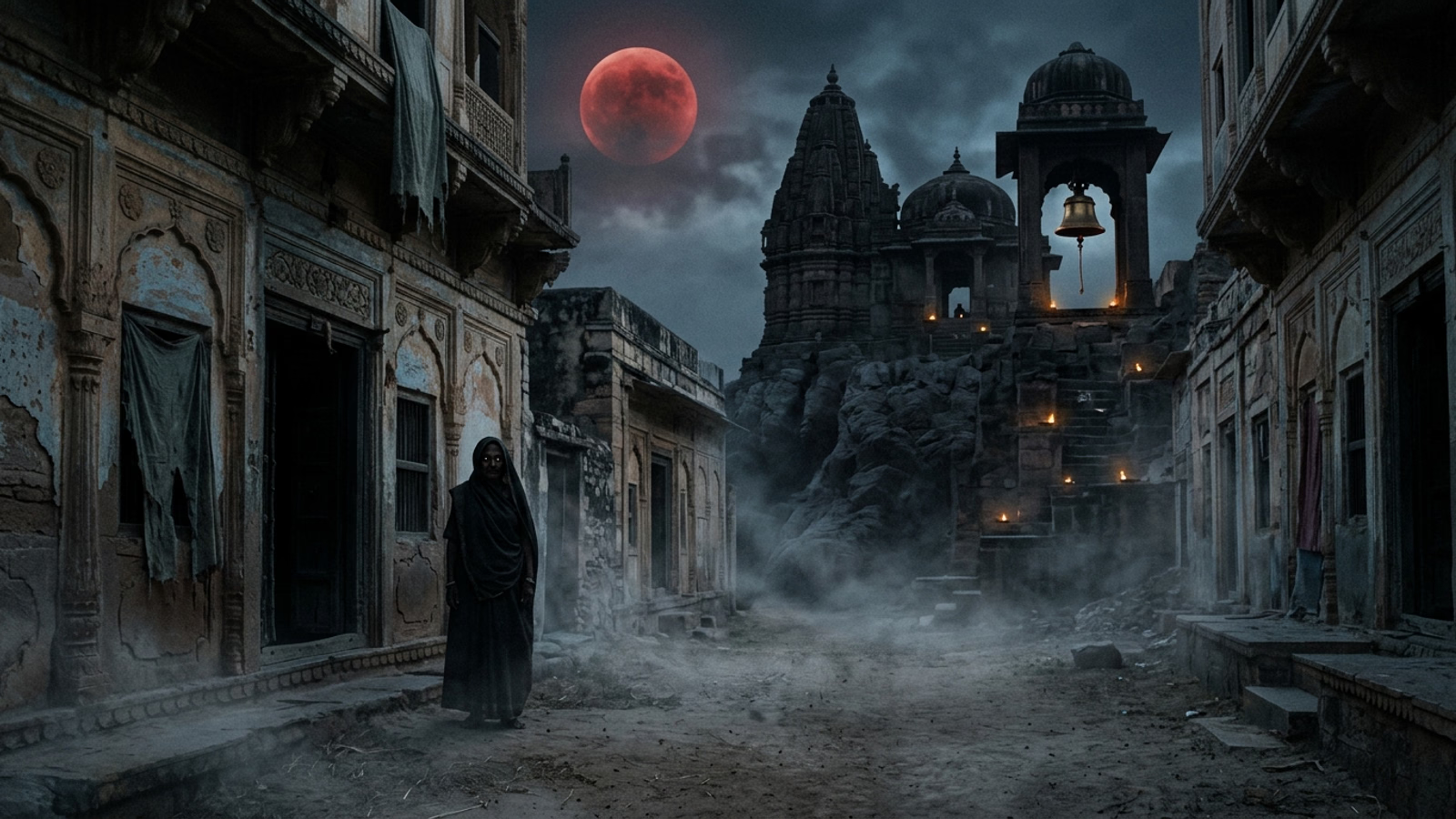
At the deserted eastern boundary of Bhanpur, a forgotten desert hamlet in Rajasthan, stood an enormous three-story ancestral haveli.
Its sandstone ramparts were deeply fissured. Its ornate carved jharokhas—cantilevered royal balconies—hung half-shattered from the facade like broken ribs. Thick, strangling banyan vines covered the arched architraves, dragging the timber gates into the dust.
Nobody had lived inside those limestone walls for nearly fifty years.
Yet every night, once the desert winds picked up and the village retreated behind padlocked doors, the residents swore they could hear movement within the ruin.
Sometimes it was the heavy, rhythmic pacing of boots across upper sandstone flagstones.
Sometimes it was the muffled, agonizing weeping of a grown woman echoing through the dry air.
And on the darkest, moonless nights of *Amavasya*, villagers swore on their ancestors' graves that they heard a hollow, melodic voice whispering their names directly into their ears.
THE LEGEND OF RAJA HARISH SINGH
According to village records dating back to 1974, the estate belonged to a wealthy feudal landlord named Raja Harish Singh. He lived within its courtyards with his wife and their beloved seven-year-old daughter, Sunaina.
One torrential monsoon night, in the middle of a ferocious thunderstorm that washed out the roads, Sunaina vanished from her nursery.
The family mobilized hundreds of laborers, searching the desert wells, the dry riverbeds, and the surrounding thorn forests.
She was never found.
A few days later, a sinister rot took hold of the haveli.
Heavy oak doors bolted from the inside swung wide open without a draft. Brass oil lamps extinguished simultaneously with a single puff of freezing breath.
And the palace servants whispered in sheer panic that they saw Sunaina's shadow—distorted, elongated, and gliding three inches above the tiled floors—prowling the dark corridors.
Then, on the seventh night of the storm, the entire family vanished.
The Raja. His wife. Fourteen domestic servants.
No bodies were ever recovered. No bloodstains were found. The silver was untouched, the food was still warm on the mahogany dining table, and every door was locked from the inside.
The haveli was declared cursed and permanently abandoned.
But the story did not end there.
SCENE 2 — THE MIDNIGHT VISITOR & THE STAIRCASE WHISPER
The Horror of the Abandoned Haveli — Scene 2: The Shadowy Haveli Staircase
In the autumn of 2026, an ambitious young architectural photographer and urban documentarian named Arjun arrived in Bhanpur.
Arjun was fascinated by abandoned colonial and royal architecture. He had heard the folklore in local tea stalls, dismissing it as the romanticized hysteria of superstitious villagers.
Carrying a professional DSLR camera with an external flash and a tactical LED flashlight, Arjun walked through the iron gates at 11:45 p.m.
The moment his boots crossed the threshold of the grand entrance hall, the outside ambient temperature plummeted.
The warm desert air vanished, replaced by an unnatural, sub-zero draft that tasted of damp mortar, stagnant well water, and decaying marigold garlands.
Arjun clicked on his flashlight.
The beam flickered erratically:
`F Z Z Z T . F Z Z Z T .`
The light illuminated towering fluted columns and cracked frescoes of ancient royal processions peeling from the walls.
Then, breaking the oppressive silence, a small, innocent child's voice drifted down from the upper mezzanine:
"**CHILD'S VOICE** "
"*(soft, melodic whisper)* "
"*"Are you here to find me?"*"
Arjun froze mid-stride, every hair on his neck standing on end.
He slowly swung the flashlight beam toward the sweeping central staircase.
The beam swept across the stone risers.
Nothing.
Only gray dust and dry banyan leaves shifting in the draft.
Arjun swallowed hard, clutching the camera strap tightly against his chest:
"**ARJUN** "
"*(voice trembling)* "
"*"Hello? Who's up there? Is anyone lost?"*"
Silence.
Driven by a dangerous mix of adrenaline and investigative stubbornness, Arjun placed his foot on the first stone step and began to climb.
SCENE 3 — THE THREE KNOCKS & THE OLD BRASS KEY
The Horror of the Abandoned Haveli — Scene 3: The Locked Wooden Door at the End of the Hall
At the top of the staircase, the second floor stretched into a cavernous, pitch-black corridor lined with dozens of arched doorways.
At the very end of the hallway stood a narrow wooden door.
Unlike the ruined archways around it, this door was intact—constructed of dark, hand-carved shisham timber and reinforced with a heavy brass keyhole mechanism.
Arjun approached cautiously. He reached out and tested the ornate brass handle.
It was locked solid.
The instant his fingers left the brass, three heavy, deliberate, hollow knocks sounded from directly on the other side of the wood:
`K N O C K .`
`K N O C K .`
`K N O C K .`
Arjun stumbled backward two steps, his flashlight beam trembling violently across the timber.
From inside the locked chamber came a muffled, breathless whimper:
"**VOICE BEHIND THE DOOR** "
"*(pleading, childish sob)* "
"*"Please open it... It's so dark in here..."*"
Arjun's heart hammered against his ribs. He looked down at a rotting mahogany console table resting against the adjacent wall.
Covered in a layer of gray dust sat a solitary, heavy antique brass key.
With shaking hands, Arjun picked up the key.
He slid it into the lock.
`C L I C K - C L U N K .`
The heavy tumblers turned with the grinding scrape of fifty-year-old iron.
Arjun pushed the door open.
"The boundary between what is real and what is myth begins to blur when the lights fade. Some things are better left undisturbed."
SCENE 4 — THE ROOM OF PHOTOGRAPHS & THE BLACK-EYED GIRL
The Horror of the Abandoned Haveli — Scene 4: The Room of Photographs and the Girl with Black Eyes
Inside was a windowless, twelve-foot chamber covered in decades of suffocating dust and spiderwebs.
In the center sat an antique wooden rocking horse, perfectly still.
And hanging across every inch of the peeling plaster walls were dozens of framed photographs.
Some were faded sepia daguerreotypes from the 1920s.
Some were black-and-white prints from the 1950s.
Some were color Kodachrome photographs from the 1970s.
Arjun raised his camera and fired the flash to illuminate the gallery:
`B L I N D I N G F L A S H !`
The harsh white strobe revealed the truth:
Every single photograph showed the exact same little girl.
Sunaina.
In every portrait across five decades of history, she wore the same traditional crimson silk lehenga and gold anklets, smiling with identical, unnatural poise.
Then Arjun's flashlight beam caught the newest photograph, hanging crookedly near the doorframe.
His blood turned to slush.
The photograph was crisp, modern, and in full high-definition color.
It showed the doorway of the room—taken from inside.
And standing in the doorway of the picture was a young man holding a flashlight and a DSLR camera:
Arjun.
And standing directly behind his left shoulder in the photograph was the little girl, her head tilted at a sickening, ninety-degree angle.
Arjun spun around with a strangled cry:
"**ARJUN** "
"# *"WHO'S THERE?!"*"
The doorway was completely empty.
There was nobody behind him.
Then, resting against his chest, the camera's LCD screen clicked awake with a high-pitched digital beep:
`B E E E P .`
A brand-new photo appeared on the screen—recorded zero seconds ago.
It showed Arjun standing in the center of the dusty room.
And standing directly behind him—her bloodless, translucent white hands resting upon his shoulders—was the girl.
Her skin was paper-white.
Her lips were stretched into a wide, stitched grin.
And her eyes were completely, bottomlessly black.
No irises. No whites. Just two sucking voids of pitch-black nothingness.
SCENE 5 — THE INFINITE LOOPING CORRIDORS
The Horror of the Abandoned Haveli — Scene 5: The Endless Looping Haveli Colonnade
Arjun didn't scream. The terror was too absolute, too physical.
He threw the door wide open, sprinted into the corridor, and raced down the central staircase three steps at a time.
He reached the ground floor, threw his shoulder against the heavy teak entrance doors, and burst out into the night—
`S L A M !`
He didn't step outside into the desert.
Arjun stumbled onto a stone floor, breathing in dust.
He looked around in disbelieving horror.
He was standing at the top of the second-floor staircase.
Looking down the exact same corridor of arched doorways he had just fled from.
"**ARJUN** "
"*(screaming in hysterical panic)* "
"# *"NO! NO! LET ME OUT!"*"
He turned and bolted toward the northern balcony door. He kicked the latch open and dove through the opening.
He didn't fall to the courtyard below.
He crashed onto the limestone flagstones of the exact same second-floor corridor.
He tried a service stairwell.
The same corridor.
He tried a shattered lattice window.
The same corridor.
The haveli had ceased to be an architecture of stone and wood. It was an inescapable, topological spiderweb.
Then, from the darkness behind him, came the sound:
`S L A P .`
`S L A P .`
`S L A P .`
Slow, deliberate, barefoot footsteps walking across cold marble.
Getting closer.
Arjun slowly, reluctantly turned his head.
Standing twenty paces down the colonnade was the little girl in the crimson lehenga.
Her black eyes gleamed in the moonlight.
Her wide, frozen smile widened until the corners of her mouth reached her earlobes:
"**SUNAINA** "
"*(dual-toned, echoing voice)* "
"# *"You opened the door."*"
SCENE 6 — THE CAMERA IN THE WEEDS & THE WAITING WINDOWS
The Horror of the Abandoned Haveli — Scene 6: The Camera in the Grass and the Windows Above
At 6:30 a.m. the following morning, two village herdsmen leading their goats past the haveli noticed something glinting in the morning dew.
Lying in the overgrown weeds at the bottom of the grand stone steps was Arjun's professional DSLR camera.
The lens was cracked. The strap was torn.
Arjun was nowhere to be found.
The local police inspector retrieved the memory card and plugged it into a terminal at the district precinct.
The card was empty of all files, except for one single, final exposure captured at 3:17 a.m.
The photograph was a panoramic, wide-angle shot of the ruined haveli exterior, illuminated by lightning.
And standing framed inside the broken, second-floor arched jharokha was Arjun.
Beside him stood the pale little girl.
Both were staring straight down the barrel of the camera lens.
Both of their eyes were completely, bottomlessly black.
And both were smiling the same wide, vacant, terrible smile.
THE HAVELI STILL WAITS
Today, nobody from Bhanpur or the surrounding districts approaches the haveli after the sun dips below the sand dunes.
Village elders say that on monsoon nights, the second-floor windows still glow with faint, sickly blue luminescence.
Travelers on the highway report hearing a young man's desperate voice calling through the trees:
"*"Please open it... It's so dark in here..."*"
Because the villagers finally understood the curse of Raja Harish Singh's estate:
Every few years, an outsider enters the ruins.
And every time someone crosses the threshold, a new photograph appears outside the front steps.
A photograph of the missing person.
Standing beside the little girl.
Smiling.
So if you ever travel the forgotten roads of Rajasthan and find an ancient, overgrown haveli standing alone beneath the desert stars, remember the golden rule of Bhanpur:
Reading scary stories can sometimes make us feel unsettled or raise our heart rate. If you are feeling spooked, anxious, or lonely at night, download Speak Anything. You can talk to a real human helper anonymously, 24/7. Get calm, zero judgment, and find peace of mind.
Explore Related Paranormal Topics & Google Searches
Click any topic to search archives
Readers investigating The Horror of the Abandoned Haveli frequently search the following documented urban legends, real supernatural encounters, and dark archives:
When Rohan bought the isolated country house empty for twenty-three years, he ignored the warning signs: no birds on the roof, dead soil around the perimeter, and no insect sounds. But the first night, every clock freezes at 3:17 a.m., an obsidian door manifests beneath the staircase leading into an impossible underground labyrinth of clawed names, and the sunrise reveals a pitch-black eclipsed sun hanging over a motionless forest. As a silent crowd gathers among the pines pointing at the house, a woman named Meera appears outside his second-floor window smiling: 'Let us in.' Two years after escaping, an unaddressed letter arrives with a single photograph and six words: 'YOU LEFT THE DOOR OPEN.'
When Arjun bought the house at the end of the narrow road, the agent gave him only one rule: 'Whatever you do, don't open the black door.' After hearing rhythmic knocks at 2:13 a.m. and his own voice calling from behind the wood, curiosity overcomes him. Opening the door reveals an impossible stone staircase descending sixty steps into a bottomless subterranean abyss—where footsteps are climbing toward him. Then the 1958 disappearance records surface, a door manifests in his bedroom ceiling, his own black-eyed future self smiles from the rain outside, and a desperate phone call reveals he has already been missing for three months. Decades later, the house collapses into ruins, but the black door remains standing alone in the dead grass—waiting to open.
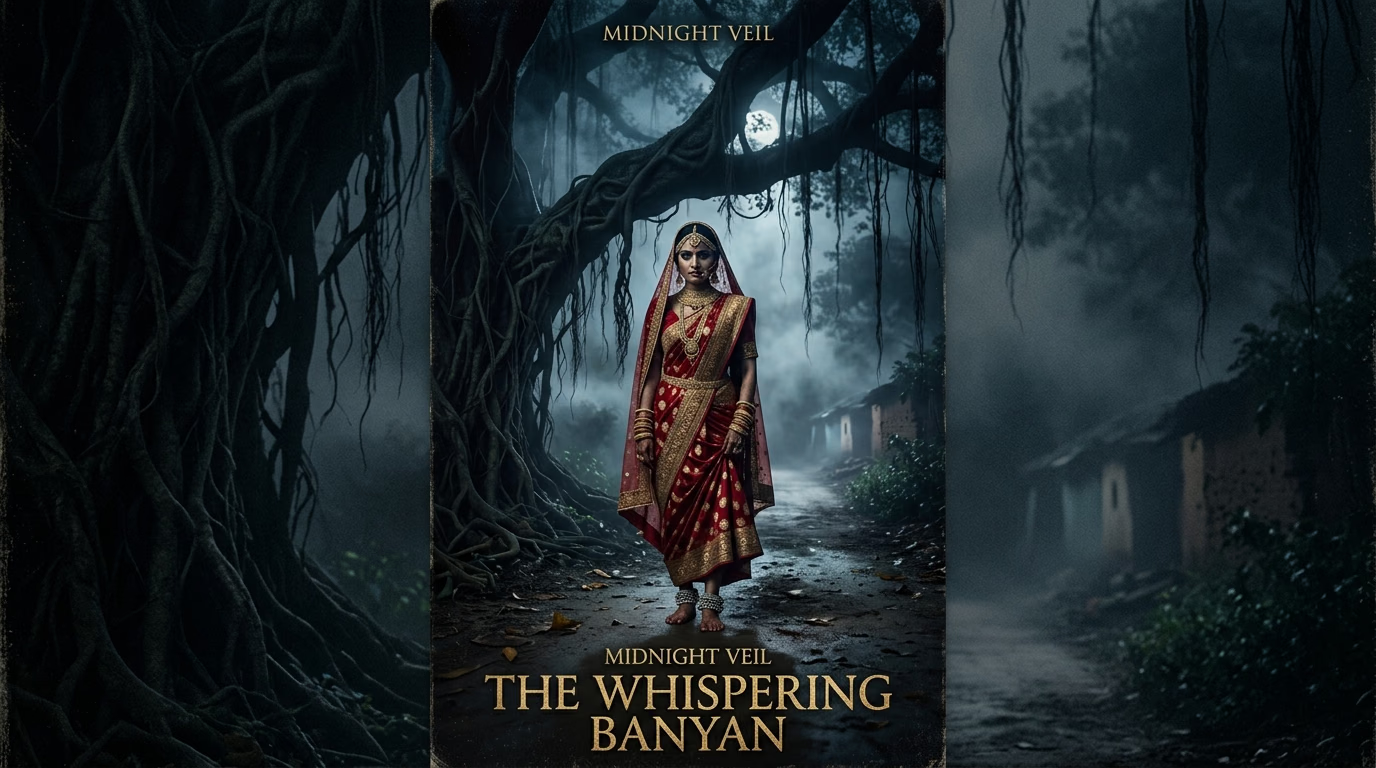
Every night, just after midnight, a woman in an ornate crimson wedding sari appeared beneath the ancient banyan tree at the edge of the village. The villagers called her The Red Bride. Men drawn by lust, greed, or gold followed her into the dark forest, only to behold her charred, cracked face and unnatural smile before disappearing forever. But years later, when a kind-hearted youth named Arjun offers her shelter in the rain without asking for her wealth, a century-old curse confronts its ultimate truth: she was never looking for someone to save her—she was looking for someone who could truly see her.
Beyond the village fields stood an ancient, blackened hut beneath a massive banyan tree. Everyone knew the rule: you could enter, explore, or even sleep inside safely, but never drink the water from the earthen pot. When twenty-two-year-old Ravi defies the superstition and drinks from the metal cup to mock his friends, a terrifying visitor appears at 3:17 a.m. with dripping wet hair covering a faceless dark void. Soon, Ravi's eyes turn pitch-black, and a woman's ancient voice speaks through his throat: 'She can't leave the hut... unless someone drinks.'
At 2:17 a.m., an old highway cut through the pitch-black wilderness like a jagged scar. When three violent robbers ambush young couple Arjun and Meera, smashing their car window and taking their lives before vanishing into the night, they believe they have committed the perfect crime. But at exactly 3:03 a.m. the following night, the abandoned car starts by itself, its dashboard flickering to life and its radio hissing: 'You took our lives. Now we'll take yours.' One by one, the killers are hunted down by an empty black sedan whose back seat carries pale passengers with void-black eyes. And once the car chooses you, there is nowhere on the highway you can hide.
Outside the isolated village of Black Hollow lay Whispering Woods, a dense, mist-shrouded forest where nobody ventured after twilight. Every night before midnight, a girl's haunting, melodic voice echoed deep among the pines, singing the same ancient nursery rhyme. Everyone knew the three unbreakable rules: Never ignore her, never disrespect her, and most importantly—never let her finish the song. When four friends enter the trees to debunk the legend, an insult turns the woods pitch black, physical bodies vanish leaving severed screaming shadows, and the final verse awakens thousands of empty-eyed lost souls waiting in the dark.