Horror Reality of Bhangarh Rajasthan: History, Dark Magic, ASI Warnings, and Real Paranormal Incidents
August 6, 2026•32 min read•By Paranormal & Historical Investigator
Audio Narrator
Listen to Horror Story Audio
Section 1: The Gateway to India's Most Infamous Haunted Realm – An Architectural and Metaphysical Overview
Across the vast desert landscapes and regal heritage of Rajasthan, Bhangarh Fort stands as a haunting monument to ancient majesty, royal glory, and dark cosmic curses (Horror Reality of Bhangarh Rajasthan). Located in the Rajgarh municipality of Alwar district, nestled at the desolate foot of the ancient Aravalli mountain range right at the border of the Sariska Tiger Reserve, this 16th-century fortress complex attracts paranormal researchers, historians, and thrill-seekers from across the globe. While Rajasthan is celebrated worldwide for its opulent golden palaces, victorious forts, and vibrant folklore, Bhangarh carries a far more terrifying distinction: it is universally recognized as the most haunted place in India and one of the most spiritually active ghost ruins on the planet. Built with magnificent local sandstone and enclosed by defensive ramparts, the sprawling fortress once contained grand multi-tiered royal palaces, bustling marketplaces, elegant courtrooms, and sacred stone temples dedicated to Hindu deities. However, behind its imposing stone walls and crumbling archways lies a dark, tragic past marked by black magic, royal tragedy, and an insurmountable dying curse that obliterated an entire flourishing civilization overnight. In parapsychological literature, as also explored in studies of Possessed Books Archive, ancient sites bound by blood, sorcery, and sudden catastrophic destruction retain intense bio-magnetic residual tethers, transforming physical structures into permanent metaphysical portals where the barrier between the mortal realm and the ghost world remains permanently shattered.
Storytelling Scene: Horror Reality of Bhangarh Rajasthan: History, Dark Magic, ASI Warnings, and Real Paranormal Incidents — Scene 1
Section 2: Geographical and Strategic Setting of Bhangarh Fort in the Aravalli Ranges
The geographical positioning of Bhangarh Fort contributes immensely to its oppressive, otherworldly atmosphere. Situated approximately 235 kilometers from India's capital city of New Delhi and 88 kilometers from Jaipur, the fortress is isolated from modern urban settlements, surrounded on three sides by the steep, dark crags of the Aravalli hills. The dense forests of Sariska wrap around the southern perimeter, creating a natural amphitheater of silent wilderness where wild beasts, wind currents, and eerie echoes howl through the mountain passes. Historically, this strategic position provided exceptional military defense, allowing royal scouts stationed on high mountain watchtowers to spot approaching enemy armies miles away. The natural streams flowing down the hillside supplied fresh spring water to the royal gardens and residential quarters, enabling Bhangarh to grow into a self-sustaining, prosperous principality. Yet, this very isolation that once protected the royal dynasty later ensured that when the dark curse struck, no external help could reach the doomed citizens. Today, as twilight approaches, the shadow of the surrounding mountains descends rapidly over the ruins, engulfing the desolate stone gates in an unnatural, bone-chilling coldness that warns all human travelers to turn back.
Storytelling Scene: Horror Reality of Bhangarh Rajasthan: History, Dark Magic, ASI Warnings, and Real Paranormal Incidents — Scene 2
Section 3: History of Bhangarh – Foundation by Raja Bhagwant Das and Prince Madho Singh in 1573 AD
To fully comprehend the horror reality of Bhangarh Rajasthan, one must trace its rich historical origins back to the late 16th century. The fortress city of Bhangarh was established in 1573 AD during the reign of the great Mughal Emperor Akbar. It was built by the formidable Amber ruler, Raja Bhagwant Das, a powerful Rajput king of the Kachwaha clan who served as a distinguished military commander in the imperial army. Raja Bhagwant Das constructed this magnificent fort city specifically as the royal seat for his younger son, Prince Madho Singh. Madho Singh was the younger brother of the legendary general Raja Man Singh I of Amber, who served as one of the nine jewels (Navratnas) in Emperor Akbar's imperial court. Under Prince Madho Singh's capable rule, Bhangarh flourished as an independent, highly prosperous principality. Thousands of skilled artisans, merchants, noble families, soldiers, and scholars migrated to Bhangarh, attracted by its wealth, religious tolerance, and grand royal patronage. Prince Madho Singh governed the kingdom with administrative acumen, expanding the city's boundaries, fortifying its stone walls, and establishing trade routes across Rajputana.
Storytelling Scene: Horror Reality of Bhangarh Rajasthan: History, Dark Magic, ASI Warnings, and Real Paranormal Incidents — Scene 3
Section 4: The Golden Era of Bhangarh – Royal Palaces, Temples, Bazaars, and Flourishing Kingdom
During its peak in the late 16th and early 17th centuries, Bhangarh was home to over 10,000 thriving residents. The urban planning of the fort city was ahead of its time, featuring five grand entrance gates: the Delhi Gate, Ajmeri Gate, Phool Bari Gate, Bhoot Bangla Gate, and the main fortified gateway. Inside the outer defensive walls lay the famous Johari Bazaar (the Jewelers' Market), a sprawling two-story stone shopping precinct where wealthy merchants traded precious gemstones, silks, spices, gold ornaments, and exotic perfumes. Further up the terraced slope stood the Raj Mahal (Royal Palace), a majestic seven-story complex constructed from fine sandstone, featuring carved balconies, royal chambers, fountains, and panoramic courtyards overlooking the entire valley. The kingdom was also renowned for its magnificent Hindu temples, which remain surprisingly intact today despite the surrounding devastation. These include the Gopinath Temple, built on a raised yellow sandstone plinth with intricate floral carvings, the Someshwar Temple dedicated to Lord Shiva, the Keshav Rai Temple, the Mangla Devi Temple, and the Hanuman Temple guarding the entrance. For several decades, Bhangarh radiated immense cultural brilliance and economic wealth, completely unaware of the dark shadow looming over its destiny.
Storytelling Scene: Horror Reality of Bhangarh Rajasthan: History, Dark Magic, ASI Warnings, and Real Paranormal Incidents — Scene 4
Section 5: The Tale of Princess Ratnavati – The Jewel of Rajasthan and Her Regal Splendor
Central to the tragic history and haunting curse of Bhangarh Fort is the legendary Princess Ratnavati, the daughter of Chatr Singh and the granddaughter of Prince Madho Singh. Historical tales and local Rajasthani folklore remember Princess Ratnavati as the jewel of Rajasthan—a woman of extraordinary grace, profound intellect, deep religious devotion, and breathtaking physical beauty. Her beauty was so celebrated across Northern India that royal suitors, princes, and kings from distant kingdoms sent marriage proposals accompanied by lavish gifts of gold, jewels, and horses, hoping to win her hand in marriage. Princess Ratnavati was not merely admired for her divine looks; she was deeply beloved by the common citizens of Bhangarh for her kindness, generosity, and spiritual devotion. She frequently visited the city's temples, supported local artisans, and ensured that the poor received food and alms. As Princess Ratnavati reached her eighteenth year, the entire kingdom of Bhangarh prepared for grand celebrations, anticipating her eventual royal marriage that would solidify strategic alliances across Rajputana.
Storytelling Scene: Horror Reality of Bhangarh Rajasthan: History, Dark Magic, ASI Warnings, and Real Paranormal Incidents — Scene 5
Section 6: The Ascetic Tantrik Singhia – The Black Magic Practitioner of the Opposite Mountain Peak
However, far away from the music, laughter, and royal luxury of the Raj Mahal, a dark energy lurked in the high mountains surrounding the fort. High on the rugged cliff peak directly facing the front mountain of Bhangarh Fort lived a sinister, reclusive occult practitioner named Wizard / Tantrik Singhia (also referred to in local legends as Tantrik Balu Nath or Singhia). Singhia was a master of dark sorcery, black magic (Jaadu-Tantra), shadow manipulation, and forbidden Goetic arts. He had abandoned societal norms to dwell in a solitary stone hermitage perched on the mountaintop, spending decades performing severe dark penances, meditating over cremation ashes, and summoning low-vibrational occult entities. Through his dark practices, Singhia had acquired supernatural powers, including the ability to cast binding love spells, control human minds, and summon lethal elemental curses. Although local villagers feared his dark reputation and avoided climbing his mountain peak, few dared to challenge him, knowing that a single curse from Singhia could bring ruin upon a person's family.
Storytelling Scene: Horror Reality of Bhangarh Rajasthan: History, Dark Magic, ASI Warnings, and Real Paranormal Incidents — Scene 6
Section 7: The Obsession of Tantrik Singhia – Watching the Queen from the Mountain Heights
From his elevated vantage point on the mountaintop hermitage, Tantrik Singhia possessed a clear, unobstructed view of the upper terraces, royal gardens, and private chambers of the Raj Mahal inside Bhangarh Fort. Every morning and afternoon, Singhia sat on his high stone cliff, using his dark occult sight and brass viewing lenses to keep a constant, obsessive eye on Princess Ratnavati as she walked through the palace courtyards. Day after day, year after year, Singhia's dark obsession grew into an insane, uncontrollable passion. He realized that as a low-caste, feared black magician dwelling in the wilderness, he could never formally approach the royal court or win the princess's hand through honorable royal marriage. Driven mad by unrequited lust and dark desire, Singhia resolved to use his forbidden black magic to subjugate Princess Ratnavati's free will, force her into a spellbound trance, and compel her to leave the safety of the royal palace to surrender herself to his mountaintop hut.
Storytelling Scene: Horror Reality of Bhangarh Rajasthan: History, Dark Magic, ASI Warnings, and Real Paranormal Incidents — Scene 7
Section 8: The Sinister Plot – The Enchanted Scented Oil (Attar/Ittar) and the Marketplace Trap
On a warm afternoon, as Princess Ratnavati prepared for an upcoming festival, she dispatched her trusted royal maid into the bustling Johari Bazaar to purchase fresh scented oil (Attar / Ittar) for her bath and hair grooming. Seeing his opportunity, Tantrik Singhia descended silently from his mountain peak in disguise and shadowed the royal maid through the crowded market lanes. As the maid handed a glass vial to the perfume merchant to be filled with pure jasmine and rose attar, Singhia secretly recited a powerful, binding black magic incantation over the glass bottle. He infused the liquid with an irresistible dark spell (Vashikaran Mantra) designed to alter the consumer's consciousness. The spell was engineered with ruthless metaphysical precision: the moment Princess Ratnavati poured the enchanted oil onto her skin, the dark magic would instantly hijack her nervous system, erase her moral awareness, and compel her to walk out of the fort gates, climb the steep Aravalli mountain slope, and throw herself willingly into Singhia's arms. Handing the enchanted vial back to the unsuspecting maid, Singhia retreated to his mountain peak, waiting eagerly to claim his prize.
Storytelling Scene: Horror Reality of Bhangarh Rajasthan: History, Dark Magic, ASI Warnings, and Real Paranormal Incidents — Scene 8
Section 9: The Princess's Intuition – Unveiling the Black Magic Spell in the Bazaar
However, Tantrik Singhia had severely underestimated the divine spiritual protection and sharp intuition of Princess Ratnavati. When the maid returned to the royal palace chambers and presented the glass vial of attar, Princess Ratnavati immediately sensed an eerie, unnatural vibration emanating from the liquid. Being deeply versed in sacred scriptures, spiritual purity, and subtle energetic awareness, the princess noticed that the oil emitted a strange, unnatural dark shimmer and smelled faintly of sulfur and ozone rather than pure flowers. Recognizing that a malevolent black magic spell had been cast upon the attar to trap her soul, Princess Ratnavati refused to let a single drop touch her skin. Walking out onto the high stone balcony of the Raj Mahal overlooking the mountain slopes, she declared her refusal to bow to dark sorcery and violently hurled the glass vial over the palace wall, sending it crashing down onto the hillside below.
Storytelling Scene: Horror Reality of Bhangarh Rajasthan: History, Dark Magic, ASI Warnings, and Real Paranormal Incidents — Scene 9
Section 10: The Rolling Boulder – The Miraculous Crushing of Tantrik Singhia
What occurred next was a astounding display of karmic retribution and magical redirection. The glass vial shattered upon impact against a massive, heavy granite boulder resting on the steep hillside below the fort. The moment the enchanted attar soaked into the porous surface of the stone, the binding Vashikaran magic unleashed its immense magnetic force. However, because the spell had been absorbed by the inanimate stone rather than a human body, the enchanted boulder became magnetically bound to the magician who had cast the spell! Driven by the dark spell's irresistible force to seek out its creator, the massive granite boulder dislodged from the hillside and began rolling back UP and across the mountain slope with terrifying speed, gravity-defying velocity, and deafening thunder. Tantrik Singhia, sitting on his mountaintop cliff waiting for the princess, looked up in horror only to see the gigantic boulder charging directly toward his hut. Before the dark sorcerer could chant a counter-spell or escape, the massive stone smashed into him, crushing his chest, spine, and limbs against the solid rock face.
Storytelling Scene: Horror Reality of Bhangarh Rajasthan: History, Dark Magic, ASI Warnings, and Real Paranormal Incidents — Scene 10
Section 11: The Dying Curse of Singhia – The Sentence of Eternal Damnation and Roofless Ruins
Lying pinned and dying beneath the crushing weight of the boulder, his body shattered and blood pouring onto the mountain soil, Tantrik Singhia was consumed by wild, demonic rage. Realizing his dark mission had failed utterly and that he was facing imminent death, the dying sorcerer summoned the entirety of his remaining dark magic bio-energy to cast a horrific, everlasting dying curse upon Bhangarh Fort. Raising his bloody hand toward the royal palace, Singhia roared a dark prophecy that echoed across the valley: *'I curse this arrogant city of Bhangarh! No soul who dwells within these stone walls shall ever know peace, prosperity, or life! The king, the queen, the princess, the nobles, and every citizen shall perish violently in blood and misery! No soul slain here shall ever achieve rebirth or transcend into heaven; their spirits shall remain bound forever in terrifying darkness, trapped within roofless ruins where no house shall ever retain a roof above its walls!'* With these terrifying words, Singhia gasped his last breath and died, leaving his curse heavy upon the air.
Storytelling Scene: Horror Reality of Bhangarh Rajasthan: History, Dark Magic, ASI Warnings, and Real Paranormal Incidents — Scene 11
Section 12: The Sudden Catastrophe – The War with Ajabgarh and Overnight Mass Annihilation
Metaphysical experts note that a dying curse uttered by a powerful black magician carries immense negative spiritual momentum. Within less than a year of Singhia's death, the dark curse manifested with catastrophic physical violence. A bitter military conflict erupted between Bhangarh and the neighboring principality of Ajabgarh, ruled by Prince Ajab Singh (the son of Madho Singh who had established a rival fort nearby). In 1635 AD, a massive army invaded Bhangarh, launching a surprise night attack on the fort city. The battle was a horrific bloodbath: the defensive walls were breached, the royal palace was set ablaze, and the defenders were ruthlessly slaughtered in the courtyards. Princess Ratnavati, King Chatr Singh, the royal family, the noble court, and over ten thousand innocent citizens were brutally put to the sword in a single night of absolute carnage. Not a single living person escaped the fort alive. True to Singhia's dying curse, the entire population of Bhangarh was annihilated overnight, leaving the grand city a blood-soaked graveyard of rotting corpses and haunting shadows.
Storytelling Scene: Horror Reality of Bhangarh Rajasthan: History, Dark Magic, ASI Warnings, and Real Paranormal Incidents — Scene 12
Section 13: The Mystery of the Missing Roofs – Why Every Structure Stands Severed in Half
Following the violent massacre, an extraordinary and baffling physical anomaly occurred across the ruins of Bhangarh—an anomaly that persists to this day and puzzles structural engineers, architects, and historians worldwide. While the thick lower stone walls, heavy foundation pillars, archways, and fortified gates of Bhangarh Fort remained standing intact, EVERY SINGLE ROOF across the entire city vanished or collapsed! From the grand Raj Mahal to the two-story shops of Johari Bazaar and the thousands of residential houses, every building appears clean-cut into half, with the top roofs completely missing from the fort structures. Whenever modern contractors, historians, or locals have attempted to repair or build a solid stone, brick, or concrete roof (chhat) over any structure inside or immediately adjacent to the fort, the roof mysteriously cracks, disintegrates, or collapses violently overnight without any seismic explanation. Local legend holds that Singhia's dark curse prohibits any living soul or ghost from having a roof over their head in Bhangarh, forcing all structural tops to remain severed under the open sky.
Storytelling Scene: Horror Reality of Bhangarh Rajasthan: History, Dark Magic, ASI Warnings, and Real Paranormal Incidents — Scene 13
Section 14: Government Acceptance – The Archaeological Survey of India (ASI) Legal Prohibition
While skeptics often dismiss ghost stories as mere folklore, Bhangarh Fort holds the unique distinction of being a location where the government officially recognizes and legally enforces the reality of paranormal danger. The Archaeological Survey of India (ASI), a premier statutory organization under the Ministry of Culture, Government of India, responsible for archaeological research and conservation of historical monuments, has taken unprecedented legal measures at Bhangarh Fort. Recognizing the persistent reports of supernatural disturbances, unexplained nighttime disappearances, disorienting magnetic shifts, and grave physical injuries suffered by reckless visitors after dark, the ASI officially declared Bhangarh Fort a strictly protected monument under tight nighttime security protocols. Unlike other historic Indian forts where night sound-and-light shows or overnight camping are permitted, the Indian government maintains an absolute, non-negotiable legal ban on human presence at Bhangarh between sunset and sunrise.
Storytelling Scene: Horror Reality of Bhangarh Rajasthan: History, Dark Magic, ASI Warnings, and Real Paranormal Incidents — Scene 14
Section 15: The Official ASI Warning Board – Legal Rules Governing Sunrise to Sunset Entry
Visitors arriving at the main entrance gate of Bhangarh Fort are immediately confronted by an official metal signboard prominently erected by the Archaeological Survey of India. The warning board, painted in bright yellow and green with bold black lettering in both Hindi and English, leaves no room for ambiguity. It explicitly reads:
*"सूर्यास्त के बाद और सूर्योदय से पहले भानगढ़ दुर्ग में प्रवेश करना सर्वथा वर्जित है। नियमों का उल्लंघन करने वालों के विरुद्ध कानूनी कार्रवाई की जाएगी।"*
*(Entering the limits of Bhangarh Fort before sunrise and after sunset is strictly prohibited. Strict legal action will be taken against anyone violating these rules.)*
The ASI board further mandates that livestock grazing inside the fort during daytime must be removed before twilight, and no government employee, researcher, or tourist is authorized to remain inside the perimeter gates after dark. Local law enforcement officers from the Alwar district police department regularly patrol the outer highway to arrest and prosecute any trespassers attempting to breach the fort walls after sunset under the Ancient Monuments and Archaeological Sites and Remains Act.
Storytelling Scene: Horror Reality of Bhangarh Rajasthan: History, Dark Magic, ASI Warnings, and Real Paranormal Incidents — Scene 15
"The boundary between what is real and what is myth begins to blur when the lights fade. Some things are better left undisturbed."
Section 16: Paranormal Rationale Behind the ASI Mandate – Disorienting Mists, Shrieks, and Vanishing Visitors
The government's uncompromising stance is grounded in decades of recorded incidents involving thrill-seekers, paranormal investigators, and local travelers who ignored warnings and attempted to stay overnight inside the fort. Historical police files from Alwar record numerous chilling accounts: in the late 20th century, a group of three young tourists equipped with flashlights sneaked past the outer wall after midnight. By 2:00 AM, local villagers residing near the highway heard blood-curdling screams emanating from the Raj Mahal ruins. When police search parties entered the fort at sunrise, they discovered two of the tourists lying unconscious with severe head trauma near the collapsed courtyard, while the third young man had completely vanished without a trace, his body never recovered. Other night visitors who survived report experiencing sudden, blinding fogs that materialize out of thin air, severe breathing difficulty, violent unseen forces pushing them toward steep drops, disembodied feminine weeping, and total electronic failure of flashlights, cameras, and mobile devices.
Storytelling Scene: Horror Reality of Bhangarh Rajasthan: History, Dark Magic, ASI Warnings, and Real Paranormal Incidents — Scene 16
Section 17: Security Guard Night Patrols – Why Guards Refuse to Stay Inside the Fort Boundaries
Even the armed security personnel appointed by the government to guard the monument refuse to step foot inside the fort walls once twilight sets in. Local guards hired by the ASI have established their security checkpost over one kilometer away from the main entrance gate, situated safely along the main road near the village boundary. When questioned by visiting journalists and researchers, senior guards openly admit that no amount of salary can tempt them to perform night patrols inside the ruins. Guards report hearing heavy iron gates slamming shut on windless nights, spectral footsteps marching across the dry leaf beds, royal palanquins passing along empty pathways, and terrifying guttural voices calling out their names from the pitch-black shadows of the Bhoot Bangla Gate. As one veteran guard famously remarked: *'During the day, Bhangarh belongs to the Government of India and tourists. But the moment the sun drops below the Aravalli peaks, Bhangarh belongs exclusively to the dead.'*
Storytelling Scene: Horror Reality of Bhangarh Rajasthan: History, Dark Magic, ASI Warnings, and Real Paranormal Incidents — Scene 17
Section 18: The Fateful TV Shoot at Bhangarh Fort – Filming Jhansi Ki Rani in the Desolate Ruins
Among the most credible and publicized real-life paranormal accounts associated with Bhangarh Fort is the harrowing experience encountered by a professional television crew during an official shooting schedule. In the early 2010s, the cast and production crew of Zee TV's widely acclaimed historical drama series *Jhansi Ki Rani* traveled to Rajasthan to film pivotal outdoor sequences. Seeking authentic historical architecture, desolate mountain backdrops, and ancient stone gateways to depict royal Rajput kingdoms, the production team secured special official permissions to shoot scenes within the sprawling precincts of Bhangarh Fort. The shooting schedule involved key lead actors, including celebrated television stars Ulka Gupta (who portrayed the young Manu / Rani Laxmibai) and veteran actor Sameer Dharmadhikari (who played King Gangadhar Rao), alongside director Nitin Vaidya, stunt coordinators, camera operators, light technicians, and makeup artists.
Storytelling Scene: Horror Reality of Bhangarh Rajasthan: History, Dark Magic, ASI Warnings, and Real Paranormal Incidents — Scene 18
It is essential to clarify a widespread internet rumor before examining the details of this incident: actors Ulka Gupta and Sameer Dharmadhikari did NOT encounter a fictional disfigured 'shooting face' ghost or physical spectral face monster during their time at the fort. Instead, what they faced was a genuinely terrifying, life-threatening real-life spooky experience—an intense, supernatural assault driven by extreme localized environmental anomalies, paralyzing psychological horror, and disorienting atmospheric forces that nearly cost the lead actress her life. As veteran actors accustomed to late-night film sets, desolate outdoor locations, and intense drama setups, neither Ulka Gupta nor Sameer Dharmadhikari anticipated that stepping inside the ancient walls of Bhangarh would trigger an encounter that would haunt their memories forever.
Storytelling Scene: Horror Reality of Bhangarh Rajasthan: History, Dark Magic, ASI Warnings, and Real Paranormal Incidents — Scene 19
Section 20: Clarifying the Myth – No Disfigured 'Shooting Face' Ghost, But Life-Threatening Paranormal Encounter
Sensationalist tabloids and clickbait blogs often fabricate exaggerated claims of actors seeing grotesque disfigured faces floating in mid-air during camera takes. However, in subsequent detailed media interviews, production press conferences, and television retrospectives, both Ulka Gupta and the production crew set the record straight. They explicitly confirmed that they did not see a cartoonish 'shooting face' ghost. Rather, they experienced an undeniable, terrifying manifestation of raw paranormal energy: an invisible, suffocating malevolence that seized physical control of the environment, disrupted electronics, caused severe physical symptoms, and created a chaotic atmosphere of visceral dread that forced seasoned professionals to abandon expensive equipment and flee for their lives.
Storytelling Scene: Horror Reality of Bhangarh Rajasthan: History, Dark Magic, ASI Warnings, and Real Paranormal Incidents — Scene 20
Section 21: The Night of Filming – Temperature Drops, Choking Energy, and Unseen Entities
The chilling sequence of events unfolded late in the afternoon as the production crew prepared to shoot crucial night scenes near the ancient archways leading up to the Raj Mahal palace. As the sun dipped below the surrounding Aravalli mountain peaks, an instantaneous, violent shift occurred in the atmosphere. The ambient temperature, which had been warm during the day, plummeted drastically within minutes, dropping to bone-chilling levels that made the crew's breath freeze into thick white vapor. Simultaneously, a heavy, suffocating static pressure settled over the stone courtyard, accompanied by an eerie, dead silence where even the ambient sounds of crickets, roosting birds, and mountain wind completely ceased. High-powered production lights flickered wildly before shutting off entirely, generator cables sparked without technical fault, and HD video cameras displayed bizarre magnetic static distortions across monitor screens.
Storytelling Scene: Horror Reality of Bhangarh Rajasthan: History, Dark Magic, ASI Warnings, and Real Paranormal Incidents — Scene 21
Section 22: Suffocation and Terror – Ulka Gupta's Harrowing Experience and Crew Panic
As the lighting equipment failed, young actress Ulka Gupta, dressed in her full historical royal costume, suddenly gasped for air, clutching her throat in agony. Witnesses on set described a terrifying sight: Ulka Gupta began experiencing severe disorientation, violent panic, and an overwhelming sensation of an invisible, heavy mass pressing down on her chest and throat, as if a malevolent entity was actively choking the life out of her. Her eyes widened in sheer terror as she pointed toward the dark stone archway behind the camera stand, whispering that several shadowy, disembodied forms were surrounding the set and watching the crew with intense, predatory hatred. Actor Sameer Dharmadhikari and senior crew members rushed forward to grab Ulka, only to feel an icy, repulsive force repelling them. Realizing that the lead actress was suffering a life-threatening physical crisis and that the entire set was under metaphysical assault, the director immediately yelled to abort the shoot. The terrified cast and crew abandoned heavy camera rigs, light stands, and props, carrying Ulka Gupta in a frantic rush out through the main gates before sunset, barely escaping the fort as dark night descended.
Storytelling Scene: Horror Reality of Bhangarh Rajasthan: History, Dark Magic, ASI Warnings, and Real Paranormal Incidents — Scene 22
Section 23: The Broadcast Legacy – How the Real Incident Inspired Zee TV's Fear Files in November 2012
The harrowing real-life experience at Bhangarh Fort sent shockwaves through the Indian television industry. The incident was widely reported in leading national newspapers and entertainment magazines, with actors and technicians publicly recounting the terrifying ordeal. The sheer intensity of this documented real-life paranormal encounter later served as the direct narrative inspiration for a special prime-time episode of Zee TV's hit docudrama horror series *Fear Files: Darr Ki Sacchi Tasveerein*. Broadcast in November 2012 (Episode 47), the special episode meticulously reenacted the chilling events experienced by Ulka Gupta, Sameer Dharmadhikari, and the *Jhansi Ki Rani* production crew at Bhangarh Fort. The episode featured on-camera interview segments, expert parapsychological commentary, and dramatic recreations, solidifying the incident as one of the most famous documented television crew haunting cases in Indian broadcast history.
Storytelling Scene: Horror Reality of Bhangarh Rajasthan: History, Dark Magic, ASI Warnings, and Real Paranormal Incidents — Scene 23
Section 24: Local Villagers' Perspective – Accepting the Ancient Curse and Living in its Shadow
To gain a complete understanding of the horror reality of Bhangarh Rajasthan, one must examine the lives of the local people who reside in the surrounding rural hamlets, such as Gola Ka Baas, Bhangarh Village, and Ajabgarh. Unlike urban tourists who view Bhangarh as an exciting weekend destination or ghost-hunting spot, the local villagers live in quiet, profound respect—and continuous fear—of the ancient curse. The villagers completely accept the historical reality of Princess Ratnavati, Tantrik Singhia's black magic, and the bloody destruction of the royal dynasty as absolute, indisputable truth passed down through generations of oral history. Local elders strictly instruct their children never to wander near the fort boundaries after afternoon prayers, and no villager will ever cross the threshold of the outer ruins after sunset under any circumstances.
Storytelling Scene: Horror Reality of Bhangarh Rajasthan: History, Dark Magic, ASI Warnings, and Real Paranormal Incidents — Scene 24
Section 25: The Roofless Homes of Gola Ka Baas – The Unspoken Law of the Collapsing Chhat
Perhaps the most striking real-world proof of the locals' belief in the curse is found in the architectural design of the surrounding villages. If one drives through Gola Ka Baas or the immediate settlements near Bhangarh, an astonishing pattern immediately catches the eye: NOT A SINGLE HOUSE POSSESSES A TRADITIONAL CONCRETE OR TILED ROOF (Chhat)! Every single home, shop, and cattle shed is built strictly with temporary thatched straw, corrugated plastic sheets, tin roofs, or open slate slabs supported by wooden beams. Local residents recount numerous harrowing instances where brave or skeptical homeowners attempted to pour modern reinforced concrete slabs (Lanter) to build a sturdy second-story roof for their families. In every single case, within days of casting the roof, the concrete structure mysteriously cracked down the center, collapsed inward injuring occupants, or brought sudden fatal illness, financial bankruptcy, and tragic deaths to the family. The villagers firmly accept this unspoken law: because Tantrik Singhia cursed Bhangarh to remain roofless forever, no human dwelling built within the shadow of the fort can ever possess a solid roof.
Storytelling Scene: Horror Reality of Bhangarh Rajasthan: History, Dark Magic, ASI Warnings, and Real Paranormal Incidents — Scene 25
Section 26: Local Taboos – Meat, Alcohol, Perfume, and Evening Vacations Around the Fort
Living in close proximity to a cursed, spiritually active realm has forced the local community to observe strict cultural taboos designed to avoid provoking the restless entities bound to the fort soil. Villagers strictly prohibit carrying raw meat, cooked non-vegetarian food, hard alcohol, or strong floral perfumes (attar) when traveling along the roads passing near Bhangarh Fort. Parapsychologists and local elders explain that negative shadow spirits and residual entities are intensely attracted to the bio-magnetic vibrations of blood, alcohol, and fragrant oils—the very medium Singhia used for his dark spell. Furthermore, shopkeepers operating small tea stalls along the outer highway close their businesses by 5:00 PM, locking their wooden shutters and retreating to their homes long before twilight. If a foreign tourist's vehicle breaks down near the fort gates at night, locals will refuse to step outside to repair it, offering shelter inside their thatched homes instead until dawn breaks.
Storytelling Scene: Horror Reality of Bhangarh Rajasthan: History, Dark Magic, ASI Warnings, and Real Paranormal Incidents — Scene 26
Section 27: The Phantom Bazaars of Amavasya – When the Cursed Fort Comes Alive on Dark Nights
While Bhangarh Fort appears as a silent, decaying stone ruin under the blazing afternoon sun, local folklore and occult researchers maintain that on specific nights of the year, the ancient fort undergoes a terrifying metaphysical metamorphosis. On the darkest night of every month—the Amavasya (New Moon / Dark Moon night)—when no moonlight illuminates the desert sky, the cursed city of Bhangarh comes violently alive with phantom activity. According to parapsychologists, the dark moon alignment acts as a powerful energetic conductor, temporarily manifesting the trapped residual memories and ghost entities of the thousands of citizens, royal guards, and nobles who perished in the 1635 massacre.
Storytelling Scene: Horror Reality of Bhangarh Rajasthan: History, Dark Magic, ASI Warnings, and Real Paranormal Incidents — Scene 27
During these dark moon nights, locals staying in distant hamlets outside the fort perimeter report hearing astounding, bone-chilling auditory phenomena echoing across the quiet valley. The deserted two-story ruins of Johari Bazaar suddenly echo with the bustling sounds of a thriving 16th-century market: phantom merchants shouting prices, spectral buyers bargaining in archaic Rajasthani dialects, the distinct clinking of silver bangles and brass anklets, and the footsteps of hundreds of unseen buyers walking across stone pathways. From the high upper terraces of the Raj Mahal, villagers report hearing the faint, mournful music of classical sitars and tanpuras, accompanied by royal court laughter, heavy footsteps of marching soldiers, and the agonizing, blood-curdling shrieks of women weeping in mortal terror. These spectral voices and ghastly echoes resonate so clearly across the open desert air that they can be easily heard by travelers standing on the outer highway miles away from the fort walls.
Storytelling Scene: Horror Reality of Bhangarh Rajasthan: History, Dark Magic, ASI Warnings, and Real Paranormal Incidents — Scene 28
Section 29: Parapsychological Analysis – Residual Hauntings, Bio-Magnetic Energy Tethers, and Curses
Parapsychologists and occult historians who have analyzed Bhangarh Fort classify its paranormal activity into two distinct categories: Residual Hauntings and Intelligent Occult Binding. The phantom bazaars, music, and marching footsteps represent classic residual energy—like a cosmic film reel playback burned into the quartz-rich sandstone of the Aravalli mountains during the sudden, traumatic massacre of 1635. However, the malignant physical attacks, respiratory distress, equipment malfunctions, and collapsing roofs point toward a far darker phenomenon: an Intelligent Occult Tether forged by Tantrik Singhia's dying black magic curse. As documented in similar parapsychological cases like Haunted Well and The Last Train, severe curses combined with massive loss of human life generate localized negative vortexes that trap human soul tethers, preventing natural spiritual ascension and creating a permanent dimensional rift.
Storytelling Scene: Horror Reality of Bhangarh Rajasthan: History, Dark Magic, ASI Warnings, and Real Paranormal Incidents — Scene 29
Section 30: Conclusion – The Enduring Legacy and Chilling Warning of Horror Reality of Bhangarh Rajasthan
In summary, the horror reality of Bhangarh Rajasthan is far more than a simple collection of scary bedtime stories or local superstitions. It is a terrifying confluence of documented 16th-century history, royal tragedy, dark black magic sorcery, official government legal prohibitions, real-life television production terrors, and deeply rooted local cultural traditions. From the tragic obsession of Tantrik Singhia and the noble purity of Princess Ratnavati to the official Archaeological Survey of India warning signboards forbidding night entry, Bhangarh stands as a grim physical monument to the dark forces that lie beyond human comprehension. The terrifying experience of actors Ulka Gupta and Sameer Dharmadhikari, reenacted in Zee TV's *Fear Files*, serves as a modern warning to humanity: some places on Earth belong to a forgotten, cursed past that should never be disturbed. As the golden sun sets behind the dark crags of the Aravalli hills and the shadow of twilight creeps over the roofless ruins of Bhangarh, the ancient stones whisper their eternal warning to all who dare approach—leave the dead to their eternal darkness, or risk becoming part of Bhangarh's endless nightmare.
Storytelling Scene: Horror Reality of Bhangarh Rajasthan: History, Dark Magic, ASI Warnings, and Real Paranormal Incidents — Scene 30
Reading scary stories can sometimes make us feel unsettled or raise our heart rate. If you are feeling spooked, anxious, or lonely at night, download Speak Anything. You can talk to a real human helper anonymously, 24/7. Get calm, zero judgment, and find peace of mind.
Explore Related Paranormal Topics & Google Searches
Click any topic to search archives
Readers investigating Horror Reality of Bhangarh Rajasthan: History, Dark Magic, ASI Warnings, and Real Paranormal Incidents frequently search the following documented urban legends, real supernatural encounters, and dark archives:
When Rohan bought the isolated country house empty for twenty-three years, he ignored the warning signs: no birds on the roof, dead soil around the perimeter, and no insect sounds. But the first night, every clock freezes at 3:17 a.m., an obsidian door manifests beneath the staircase leading into an impossible underground labyrinth of clawed names, and the sunrise reveals a pitch-black eclipsed sun hanging over a motionless forest. As a silent crowd gathers among the pines pointing at the house, a woman named Meera appears outside his second-floor window smiling: 'Let us in.' Two years after escaping, an unaddressed letter arrives with a single photograph and six words: 'YOU LEFT THE DOOR OPEN.'
When Arjun bought the house at the end of the narrow road, the agent gave him only one rule: 'Whatever you do, don't open the black door.' After hearing rhythmic knocks at 2:13 a.m. and his own voice calling from behind the wood, curiosity overcomes him. Opening the door reveals an impossible stone staircase descending sixty steps into a bottomless subterranean abyss—where footsteps are climbing toward him. Then the 1958 disappearance records surface, a door manifests in his bedroom ceiling, his own black-eyed future self smiles from the rain outside, and a desperate phone call reveals he has already been missing for three months. Decades later, the house collapses into ruins, but the black door remains standing alone in the dead grass—waiting to open.
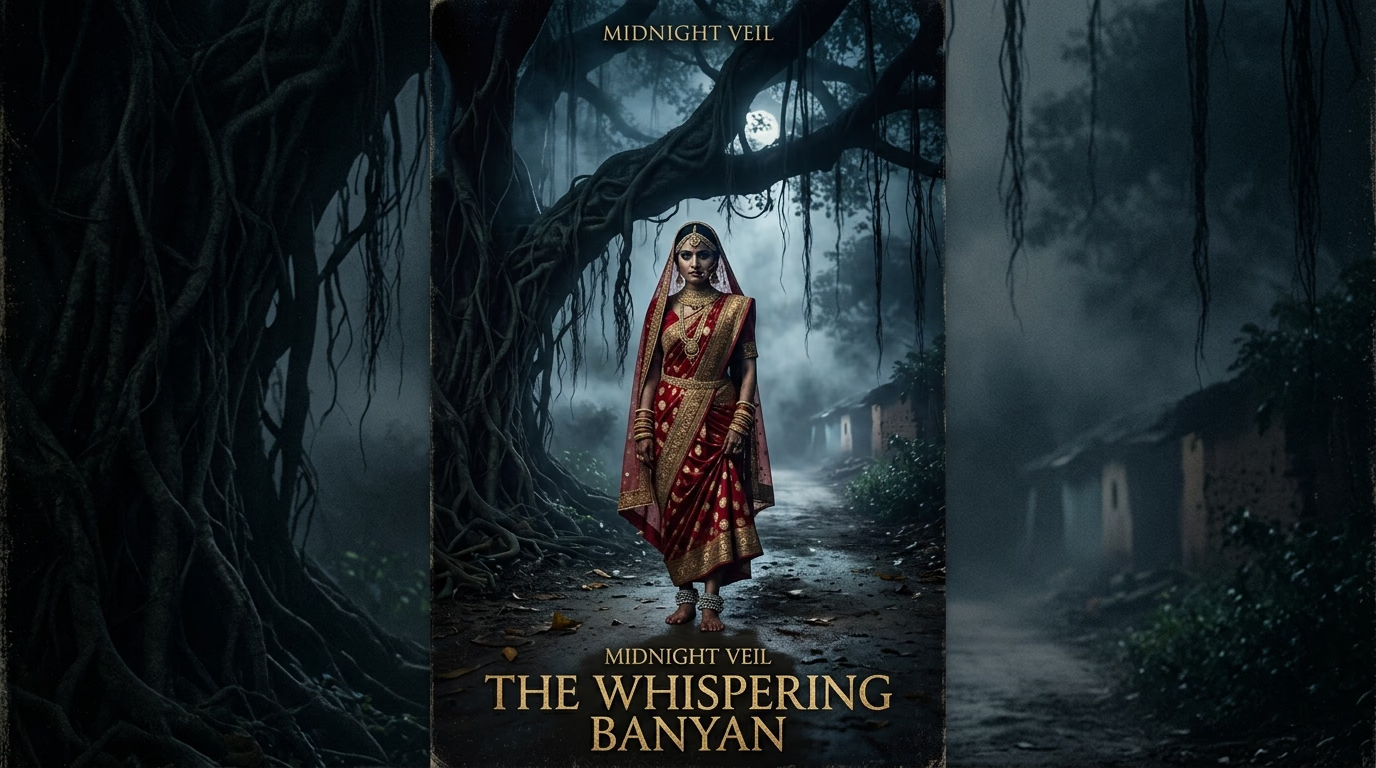
Every night, just after midnight, a woman in an ornate crimson wedding sari appeared beneath the ancient banyan tree at the edge of the village. The villagers called her The Red Bride. Men drawn by lust, greed, or gold followed her into the dark forest, only to behold her charred, cracked face and unnatural smile before disappearing forever. But years later, when a kind-hearted youth named Arjun offers her shelter in the rain without asking for her wealth, a century-old curse confronts its ultimate truth: she was never looking for someone to save her—she was looking for someone who could truly see her.
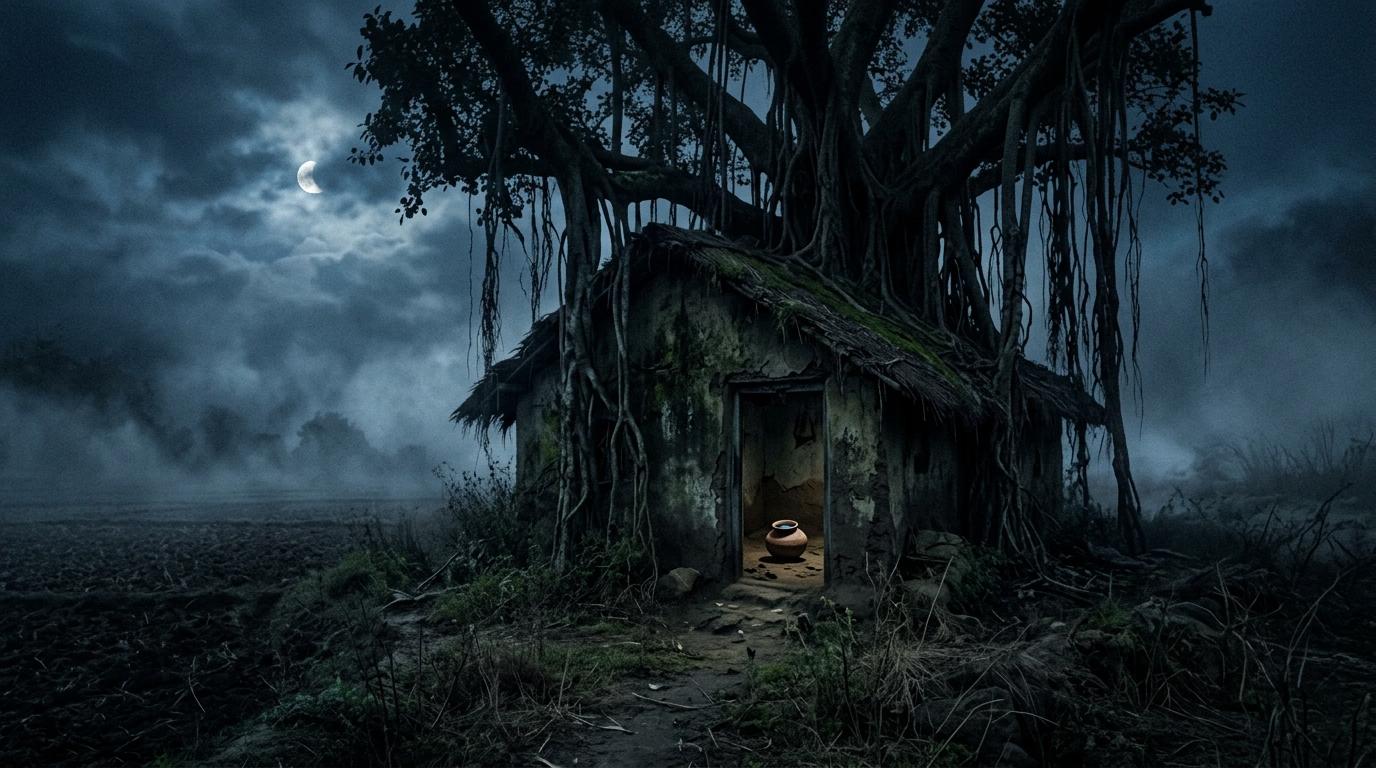
Beyond the village fields stood an ancient, blackened hut beneath a massive banyan tree. Everyone knew the rule: you could enter, explore, or even sleep inside safely, but never drink the water from the earthen pot. When twenty-two-year-old Ravi defies the superstition and drinks from the metal cup to mock his friends, a terrifying visitor appears at 3:17 a.m. with dripping wet hair covering a faceless dark void. Soon, Ravi's eyes turn pitch-black, and a woman's ancient voice speaks through his throat: 'She can't leave the hut... unless someone drinks.'
At 2:17 a.m., an old highway cut through the pitch-black wilderness like a jagged scar. When three violent robbers ambush young couple Arjun and Meera, smashing their car window and taking their lives before vanishing into the night, they believe they have committed the perfect crime. But at exactly 3:03 a.m. the following night, the abandoned car starts by itself, its dashboard flickering to life and its radio hissing: 'You took our lives. Now we'll take yours.' One by one, the killers are hunted down by an empty black sedan whose back seat carries pale passengers with void-black eyes. And once the car chooses you, there is nowhere on the highway you can hide.
Outside the isolated village of Black Hollow lay Whispering Woods, a dense, mist-shrouded forest where nobody ventured after twilight. Every night before midnight, a girl's haunting, melodic voice echoed deep among the pines, singing the same ancient nursery rhyme. Everyone knew the three unbreakable rules: Never ignore her, never disrespect her, and most importantly—never let her finish the song. When four friends enter the trees to debunk the legend, an insult turns the woods pitch black, physical bodies vanish leaving severed screaming shadows, and the final verse awakens thousands of empty-eyed lost souls waiting in the dark.